

Abstract
The study of life course patterns of offending, or criminal careers, offers particular insight into economic and social costs associated with offending, more broadly, as well as the need to prevent such costs. As such, a large literature is devoted to identifying various patterns of offending, as well as the risk/protective factors associated with these patterns to prevent their manifestation. Using data from the Rochester Youth Development Study (RYDS), this work first estimates adolescent to middle adulthood patterns of self-reported offending (ages 14–48) using group-based trajectory models (n = 873). Then, using mulinomial logistic regression models, it examines how adverse childhood experiences (ACEs), are individually, cumulatively, and conceptually (Dimensional Model of Adversity and Psychopathology; DMAP) related to and distinguish between the various, identified patterns of offending. Seven general patterns of self-reported offending emerged, including non-offending, chronic, and late-bloomer offending patterns. Additional patterns followed a more age-normative pattern of offending (bell-shaped curve) but varied in the timing and frequency of offending. Various individual ACEs and the cumulative number of ACEs distinguished between the pattern of non-offending and all other patterns of offending, but only homelessness and sexual abuse distinguished between patterns that involved offending. ACEs in the form of threats or deprivations, in line with the DMAP perspective, offered limited utility in distinguishing between patterns of self-reported offending. Findings suggest the need to target particular ACEs to stymie longer-term patterns of offending that may be particularly costly to individuals and society.
“Life-course criminology now is criminology” (Cullen, 2011: 301). The rise of prospective, longitudinal studies that follow cohorts of individuals over multiple phases of the life span (e.g., Cambridge Study of Delinquent Development, the Dunedin Study, Glueck Data, National Longitudinal Study of Adolescent to Adult Health, Project on Human Development in Chicago Neighborhoods, and National Longitudinal Study of Adolescent to Adult Health) have reinforced this sentiment as they allow for a more comprehensive study (and understanding) of offending. As these studies have aged, the study of offending and criminal justice contact, more specifically (i.e., arrest/conviction), has moved beyond a focus on adolescence and/or emerging/early adulthood to encompass the prevalence and frequency of crime spanning the life course (e.g., Blokland & Nieuwbeerta, 2005; Poulton et al., 2015, 2023; Sampson & Laub, 2017). As a result, more attention has been given to the patterns and processes associated with persistence, desistance (see Bersani & Doherty, 2018 for a review), and late-onset offending (e.g., Liu et al., 2022; Matsuda et al., 2022). Not only are these patterns informative with respect to policy and practice (e.g., sentencing policies based on notions of aging out of crime), but they also provide the opportunity to explore how various risk/protective factors are related to different patterns of offending across the life course. The latter is particularly beneficial to effectively identify and allocate resources for targets for prevention and intervention that will be impactful in the near- and long-term. With respect to life-course patterns of offending, it is particularly prudent to examine childhood and adolescent correlates, as these two periods of the life course are formative with respect to individual development (Backes & Bonnie, 2019; Richter et al., 2019), including brain, anatomical, emotional, and social development. Childhood, in particular, is a period of particular risk for various theories that invoke the notion of population heterogeneity (e.g., Moffitt’s [1993] Dual Taxonomy and Gottfredson and Hirschi’s [1990] General Theory of Crime) to account for persistent offending across the life course. Similarly, childhood and adolescence are relevant to theories grounded in the notion of state dependence to explain patterns of persistent offending, whereby early life experiences can set off a cascade that promotes subsequent offending. It is not surprising, then, that these two periods in the life course are focal points for prevention and intervention programming that seek to reduce the prevalence of risk factors and strengthen protective factors to prevent subsequent maladaptation (Kisling & Das, 2023; Odom et al., 2012), including offending. Among identified risk factors are adverse childhood experiences (ACEs), as prior work suggests that ACEs are related to criminal behavior and criminal justice contact in adolescence and early adulthood (e.g., Testa et al., 2022). As such, some practitioners argue that criminal justice personnel, including law enforcement, should be aware of the correlation between ACEs and offending, particularly among adolescents, in order to promote a more holistic approach to reducing juvenile crime (e.g., Freeze, 2019). Given the need to further elucidate patterns of offending across the life course as data become available, as well as the childhood and adolescent correlates of these patterns of behavior, the goals of this study are twofold. First, we use recently collected data from the Rochester Youth Development Study, a prospective, longitudinal study which began in 1988, to model patterns of self-reported offending spanning adolescence through middle adulthood (age 48). Notably, the Rochester Youth Development Study, along with its intergenerational extension, the Rochester Intergenerational Study, asked participants to self-report involvement in multiple, mutually exclusive offending behaviors at several points in time during adolescence, emerging adulthood, early adulthood, and middle adulthood. The modeling of patterns of offending, and not criminal justice contact in the form of arrests or convictions, with detailed data spanning the latter years of early adulthood (30s) and middle adulthood are rare, even though growing attention has been given to these stages in the life course with respect to late-onset offending and desistance (Bersani & Doherty, 2018; Gibson & Krohn, 2012). Second, this study examines whether ACEs can distinguish between different patterns of offending (instead of non-offenders vs. at least some offending) spanning adolescence to middle adulthood. In doing so, it expands upon traditional measurement of ACEs as either an individual or cumulative risk factor and draws upon the work of McLaughlin et al. (2014, 2015) to additionally classify ACEs as either threats or deprivations, given that each construct is known to differentially impact development and subsequent individual functioning. In doing so, this work engages in a comprehensive analysis of the potential risk associated with childhood adversity to provide a more nuanced understanding of risk factors that distinguish between various patterns of offending across the life course.
Patterns of Offending Across the Life Course
It is well established that the age-crime curve provides a summary representation of offending across the life-course which masks important variations in patterns of offending (Krohn et al., 2012). These various patterns are defined by elements of the criminal career in terms of participation, frequency/rate of offending, and duration (Blumstein & Cohen, 1987). The rise of group-based trajectory analysis (Nagin & Land, 1993) and latent growth curve modeling (Muthen & Muthen, 2000) to identify various patterns of offending have contributed to the effort to better understand various patterns or trajectories of offending, notwithstanding the limitations associated with each method to identify “groups” of offenders (Skardhamar, 2010; see also McGee et al., 2021). While the number of trajectories or patterns of offending vary across studies (most often between four and seven groups), commonly identified trajectories of offending include a pattern of non-offending (a pattern that is described by none or rare, infrequent involvement in offending across the period of the life course investigated), chronic offending (a pattern represented by continuous, elevated levels of offending across the period of the life course investigated), adolescent-limited offending (a pattern where there is evidence of offending during adolescence and emerging adulthood followed by a subsequent reduction in offending to levels near non-offending; for a review, see McGee et al., 2021). Notably, when self-reported offending, instead of criminal justice contact (e.g., arrest), is used to model patterns of offending, models tend to identify a “late-bloomer” or adult-onset pattern of offending (a pattern that demonstrates little evidence of offending in adolescence but then includes an increase in offending in adulthood that becomes persistent; e.g., Liu et al., 2022; Matsuda et al., 2022).
Various theoretical perspectives offer explanations for the different patterns of offending. For instance, many perspectives attempt to account for chronic or persistent offending across the life course, and these assertions are grounded in the notion of population heterogeneity. Population heterogeneity explanations attribute patterns of offending, including persistent offending, to an initial (established early in life) propensity to commit crime (e.g., Gottfredson & Hirschi, 1990; Moffitt, 1993) that reverberates over time and results in a pattern of continuous offending and other antisocial behaviors that begin early in life and reamin stable (Nagin & Paternoster, 2000, pg. 119). Gottfredson and Hirschi’s (1990) General Theory of Crime attributes persistent offending to low levels of self-control and argues that various patterns of offending are distinguished by (relative) levels of self-control. Moffitt’s (1993) dual taxonomy, on the other hand, suggests that there is a group of individuals that engage in persistent offending over the life course, beginning in childhood, and this pattern results from an interaction between neuropsychological deficits and criminogenic/high risk environments. Other theoretical perspectives draw upon a state dependence argument to explain elevated and persistent offending (e.g., Laub & Sampson, 1993; Thornberry, 2005). According to these perspectives, there is a relationship between past and subsequent criminal behavior such that committing a crime alters an individual’s circumstances so the likelihood of additional offending increases (Nagin & Paternoster, 2000, pg. 118). Mechanisms that promote persistence are often called “turning points” and include labeling by the criminal justice system, weak or broken social bonds, and off-time transitions to adulthood (e.g., Sampson & Laub, 1993; Thornberry, 2005).
Additionally, various theoretical perspectives attempt to account for patterns of offending that are limited to adolescence and/or early adulthood, thus presenting a pattern marked by early offending and then what appears to be desistance (for a discussion, see Bushway & Paternoster, 2013. Moffitt’s (1993: p. 686) dual taxonomy of offending argues that offending itself is nearly universal in adolescence, and a majority of adolescents offend during adolescence in an effort to mimic life-course persistent offenders in order to achieve perceived adult or “mature status.” Sampson and Laub (1993, 2003) noted that many who engage in offending during adolescence often age-out with newly formed social bonds in adulthood, including marriage and employment, that provide supervision and monitoring, structure to routine activities, and allow for shifts in identity away from an offender/delinquent (see also Giordano et al., 2003). Similarly, Paternoster and Bushway (2009; Paternoster et al., 2015) highlight the importance of identity and cognitive-based transformations that occur as individuals age-out or desist from crime.
While the identification of other patterns of offending, including adult-onset or late-bloomer groups, is prevalent across various longitudinal studies (for a review, see Matsuda et al., 2022), little attention has been given to the etiological factors that give rise to such patterns of offending (e.g., Moffitt, 1993). Moreover, additional research is needed that identifies childhood and adolescent risk factors that can potentially differentiate between the various patterns of offending in order to further speak to various and sometimes competing theoretical perspectives as well as early targets for prevention and intervention. To date, prior scholarship has been able to identify changes in cognition and turning points that occur later in the life course to distinguish between various patterns of offending (e.g., Sampson et al., 2006; Kirk, 2017; Thomas & Vogel, 2019), but there is limited evidence regarding the utility of childhood and adolescent risk factors to inform variation in the longer-term patterns of offending (see McGee et al., 2021). Further, the limited evidence accumulated thus far suggests it is a difference in degree and magnitude of risk (and not risk factors themselves) that distinguish between various patterns of offending (Farrington et al., 2017, 2023; for an exception see Tarnhall et al., 2023). Arguably, if individual risk factors or domains of risk can be identified that distinguish between different patterns of offending, then prevention programming can directly target the specific risk factors and domains associated that are associated with patterns of offending that are particularly costly to society (Cohen et al., 2010).
Conceptualization and Measurement of Adverse Childhood Experiences (ACEs)
Adverse childhood experiences (ACEs) are defined as (potentially) traumatic events or experiences that occur before the age of eighteen (CDC, 2024). ACEs include the following: physical/sexual abuse or neglect; witnessing violence (home or community); having a family member attempt or die by suicide; having someone in the household with substance abuse or mental health problems; parental separation; having a member of the household incarcerated; and homelessness (Felitti et al., 1998). Estimates suggest that approximately 64% of adults have experienced at least one ACE before the age of 18, while 17% of adults have experienced four or more ACEs (Swedo et al., 2023). The cause for concern regarding the prevalence and frequency of ACEs is related to a host of short- and long-term effects that touch virtually every domain of life. In the short-term, the prevalence and frequency of ACEs are related to mental health problems (Elkins et al., 2019; Lee et al., 2022), suicide ideation and attempts (Dube et al., 2001), substance use (e.g., Boccio et al., 2022; Fagan & Novak, 2018), delinquency (e.g., Baglivio et al., 2015; Leban & Gibson, 2020), and school related issues such as dropping out (Morrow & Villodas, 2018), poor attendance (e.g., Blodgett & Lanigan, 2018; Crouch et al., 2019a), and failure to meet grade level standards (e.g., Crouch et al., 2019a; Jackson et al., 2021). ACEs also are related to longer-term consequences in adulthood, including mental health problems (e.g., Desch et al., 2023; Kim, 2017), offending (Craig et al., 2017), and substance abuse (Kim, 2017; Lee & Chen, 2017). Other long-term consequences include unemployment (e.g., Hansen et al., 2021) and various diseases and medical conditions (e.g., Godoy et al., 2021; Monnat & Chandler, 2015; Sachs-Ericsson et al., 2017). Theoretically (and empirically), ACEs are linked to the various short- and long-term outcomes through stress-response system dysregulation (McEwen, 2017), which negatively impacts individual development and functioning.
Prior research linking ACEs to negative outcomes relies upon either the single adversity approach or the cumulative risk approach. The former focuses on a single type of adversity or ACE and examines how it is related to an outcome, such as offending in adulthood (e.g., child maltreatment [Reckdenwald et al., 2013] and parental incarceration [Mears & Siennick, 2016]). Alternatively, the cumulative risk approach acknowledges that ACEs often do not occur in isolation (McLaughlin & Sheridan, 2016) and focuses on the combined impact of ACEs. This approach uses a count measure that combines various types of adversity or ACEs (Evans et al., 2013) or a threshold measure (e.g., 4 or more ACES; Centers for Disease Control, 2024) using the argument as ACEs accumulate or reach a threshold of accumulation, individuals experience prolonged and continued activation of the stress response system, and this negatively impacts the developing brain, as well as immune, metabolic, and cardiovascular systems (Center for the Developing Child, 2018).
In this vein, a growing body of research uses the cumulative risk approach to link ACEs to offending, primarily assessed through criminal justice contact. Testa and colleagues (2022) found a relationship between ACEs and arrest and incarceration in early and middle adulthood (up to age 43; see also Craig et al., 2017). Moreover, the relationship was significantly enhanced when individuals experienced more than four types of ACEs. Kerridge and colleagues (2020) examined the relationship between ACEs and patterns of incarceration, delineated by whether an individual was never in jail or a correctional facility (non-offender), whether an individual was in jail or a correctional facility prior to the age of 18 only (adolescent-limited), whether an individual was in jail or a correctional facility only after the age of 18 (adult-onset), and whether an individual was in a jail or correctional facility before and after the age of 18 (life-course persistent). Notably, the prevalence of experiencing an ACE was greater among the adolescent-limited, adult-onset, and life-course persistent groups compared to the non-offender group, and the life-course persistent group experienced a greater number of ACEs compared to the adolescent-limited and adult-onset group. Similar results were found by Baglivio and colleagues (2015). Five or more ACEs differentiated between patterns of arrest among a sample of juvenile offenders from Florida, particularly early-onset and chronic offending groups. Overall, findings suggest that ACEs are associated with offending that spans adolescence and early adulthood, although the true impact on behavior and whether individual or groupings of ACEs can differentiate between different patterns of actual offending behavior spanning adolescence to middle adulthood are unknown.
Moving beyond the singular adversity and cumulative risk approaches, the Dimensional Model of Adversity and Psychopathology (DMAP; McLaughlin et al., 2014) offers an alternative way to conceptualize and understand the relationship between ACEs and various (negative) outcomes, as some adversities have distinct effects on cognitive, emotional, and neural development (Lambert et al., 2017; McLaughlin & Sheridan, 2016; McLaughlin et al., 2014; Sheridan & McLaughlin, 2014). Specifically, the DMAP perspective conceptualizes ACEs into two distinct dimensions – threats and deprivations - each of which has varying implications for development and behavior.
The first dimension of adversity are identified as “threats” consists of (traumatic) experiences that involve harm or the threat of harm (McLaughlin & Sheridan, 2016). ACEs that map onto this dimension include witnessing domestic violence or being a victim of physical or sexual abuse. Threats negatively impact an individual’s fear-learning process. Individuals with normal fear-learning are able to discriminate between safe and unsafe environments and select behavior and environments accordingly. However, adversities in the form of “threats” can disrupt the fear-learning process, and neurobiologists argue that deficits in fear-learning are a robust risk factor for persistent antisocial behavior (Eysenck, 1976). Threats can also affect behavior through increased emotional reactivity and deficits in automatic emotional regulation (Busso et al., 2017; McLaughlin et al., 2015). Miller and Marsee (2019) demonstrated that emotional numbing and hyperarousal (i.e., increased emotional activity) were associated with higher rates of offending, callous-unemotional characteristics, and proactive aggression among a sample of detained male adolescents. Notably, both callous-unemotional traits and aggression are also predictors of offending in adolescence and early adulthood (for a review, see Jolliffe et al., 2017). Moreover, there is evidence to suggest a linkage between threats and offending behavior as threats are associated with higher anger dysregulation (Awada et al., 2025), and anger dysregulation is associated with more extensive histories of violent behavior (e.g., Roberton et al., 2014).
“Deprivations” are the second dimension of adversity in the DMAP perspective. They consist of experiences that involve an absence of an expected environmental input. ACEs that map onto this dimension include living in poverty, experiencing neglect, and separation from parents (McLaughlin & Sheridan, 2016; McLaughlin et al., 2014; Sheridan & McLaughlin, 2014). Deprivations thwart cognitive development due to an “absence of expected cognitive inputs and stimulation and the lack of consistent interactions” (McLaughlin & Sheridan, 2016: 241). Thwarted or limited cognitive development is associated with deficits in reward-learning and higher-order learning (McLaughlin & Sheridan, 2014). Both are related to executive functioning, and deficits in executive functioning are consistently related to offending, with evidence of lower executive functioning among justice-involved youth (Griffith et al., 2024; see also Zou et al., 2013) and adults (Bergeron & Valliant, 2001). A recent meta-analysis indicated that while lower executive functioning was related to offending in adulthood but not adolescence (Griffith et al., 2024).
Applications of the DMAP perspective to specific behavioral consequences are limited due to the infancy of the perspective. However, it is possible that these different dimensions of adversity may provide more nuance to the relationship between ACEs and various patterns of offending. Although prior research suggests that patterns of offending are distinguishable by differences in degree of risk (number and magnitude; Jolliffe et al., 2017; Howell & Egley, 2005), it also may be that dimensions of risk in terms of threats and deprivations can provide further insight between different patterns of offending through adulthood and further (theoretically) account for why these varying patterns emerge.
Current Study
The goals of this study are twofold. First, this study seeks to identify various patterns of self-reported offending spanning adolescence through middle adulthood (ages 14–48). In doing so, it seeks to extend prior work using self-reported behavior to identify various patterns of offending while also serving as a complement to other work that relies upon criminal justice contacts to identify patterns of offending across the life course (e.g., Farrington et al., 2023; Laub & Sampson, 2006). Second, upon identification of various patterns of offending, individuals will be classified into approximate patterns of offending in line with the recommendations of Roeder (1999) and the relationship between ACEs and these various patterns will be explored. Specifically, we evaluate the utility of various measurement strategies of ACEs, including the single adversity approach, the cumulative risk approach, and the DMAP perspective to determine if and how ACEs may be related to patterns of offending. Overall, the goal is to ascertain which approach is more informative with respect to risk factors associated with the various patterns of offending in order to inform more (targeted) effective prevention and intervention programming.
Data and Methods
Data come from the Rochester Youth Development Study (RYDS) and its intergenerational extension, the Rochester Intergenerational Study (RIGS). RYDS is a prospective, longitudinal study first established as part of the Office of Juvenile Justice and Delinquency Prevention’s effort to study the development of delinquency and drug use during adolescence.Footnote 1 RYDS began in 1988 with a sample of 1,000 youth who were representative of the 7th and 8th grade public school population in Rochester, New York during the 1987–1988 school year. The sampling design was selected to ensure demographic diversity, including both males and females, different racial and ethnic groups, and youth from all socioeconomic levels. The primary sampling objective of RYDS was to include a relatively high number of serious, chronic delinquents given their low prevalence in the general population (Huizinga & Elliott, 1986). To do this, RYDS oversampled males (3:1) and adolescents who lived in census tracts with a high proportion of adult offenders (based on arrest rates from the Rochester Police Department in 1986). A more detailed description of the research design and sampling strategy can be found elsewhere (Farnworth et al., 1990). The initial sample was 73% male (27% female); 68% were Black, 17% were Hispanic, and 15% were white. Further, the sample of youth selected for participation represented the entire socioeconomic spectrum of youth from Rochester, New York (Farnworth et al. 1990).
To date, RYDS consists of four phases of data collection. Phase 1 began in the spring of 1988 and consisted of nine semi-annual interviews (waves 1–9) with the focal participant of RYDS (i.e., the youth). Participants were, on average, between 14 and 18 years of age during Phase 1. Phase 2 commenced in 1995. It consisted of three annual interviews (waves 10–12) with the focal participant (approximate ages of 21–23). Focal participant interview data from Phase 1 and Phase 2 were supplemented with semi-annual (Phase 1, waves 1–8) and annual (Phase 1, waves 10–12) interviews with a primary caregiver. Phase 3 began in 2003 and consisted of two biannual interviews (waves 13 and 14) when participants were, on average, between 29 and 31 years of age. Phase 4 was initiated in 2021. It is comprised of two biannual interviews with the focal participant. Wave 15 interviews were completed in 2022; wave 16 interviews will conclude at the end of 2025. Phase 4 will also include the collection of criminal history record information (not yet available). By the end of Phase 1, 88% of the original sample had been retained; 85% were retained by the end of Phase 2, and 80% were retained through Phase 3. Phase 4 is currently underway and the participation rate through wave 15, which was initiated after a 15-year gap in data collection, is approximately 61%. RYDS retention rates in Phases 1–3 are more than acceptable for a longitudinal study (Fewtrell et al., 2008), and the retention rate thus far in Phase 4 is not uncommon for longitudinal studies of this duration, particularly after such a large gap in data collection and focus on higher risk/delinquent populations (Hanna et al., 2014).
The intergenerational extension of RYDS, RIGS, began in 1999. A detailed description of RIGS and its research design can be found in Thornberry et al. (2018). Only a brief summary is provided. The focal participant of RIGS is the first-born biological child of the original RYDS participants (i.e., youth). RIGS enrolled 370 children in Year 1, average age of 6 (range 2–13 years old), along with the original RYDS participant and the other primary caregiver of the child. Each subsequent year, new firstborn biological children of original participants were identified and invited to participate in RIGS when the firstborn child turned two years old. Upon enrollment, the original RYDS participant and other primary caregiver (if the original RYDS participant was male) completed yearly interviews until the focal child turned 18. Once the child turned 8 years of age, the child then completed yearly interviews. RIGS collected yearly interviews from enrolled participants (focal children, original RYDS participants, and other primary caregivers), when eligible, spanning 1999–2019 (Years 1–20). As of Year 20 of RIGS, 539 children and 544 original RYDS participants had enrolled in RIGS. Although original RYDS participants who participated in RIGS were more likely to be female, Black, and in grade 8 at the start of the study, RYDS focal participants who participated in RIGS adequately represented the full RYDS panel (for a review, see Thornberry et al., 2018).
All data collection and consent procedures for RYDS Phases 1–3 and RIGS Years 1–20 were approved by the University at Albany Institutional Review Board. All data collection and consent procedures for RYDS Wave 15 were approved by the Institutional Review Board at the University of Texas at San Antonio.
Measures
Offending
Beginning in wave 2 of RYDS, participants were asked whether they engaged in up to 31 offenses, including property crimes (e.g., “damaged or destroyed someone else’s property on purpose”, “taken a car without the owner’s permission”), violent crimes (e.g., “use a weapon or force to make someone give you money or things”, “hit someone with the idea of hurting them”), and drug sales (e.g., marijuana or hard drugs [crack, heroin, cocaine, etc.]) in a specified recall period (last wave, approximately six months in Phase 1; last year in Phases 2–4). If a participant answered affirmatively, then he or she was asked how many times one engaged in the act in the specified recall period. Similarly, in RIGS, participants were asked to report on the prevalence and frequency of involvement in up to 21 offending behaviors in the past year.
The measure of offending is a count of the frequency of offending across 18 mutually exclusive offending behaviors in the past year. Data in Phase 1 (waves 2–9) were combined to create yearly frequency measures of offending (e.g., the frequency from waves 2 and 3 were combined to create a yearly frequency of offending). Thus, there are four yearly measures of offending constructed from Phase 1 data, three yearly measures of offending from Phase 2, two yearly measures of offending taken from Phase 3, up to eight yearly measures of offending from RIGS data (offending spanning RIGS Years 9–16 [2008–2015]), and one yearly measure of offending from Phase 4 data. A full list of the items included in our yearly measures of offending, including question wording, can be found in the Appendix (Table 4).
ACEs
In wave 15, RYDS participants were queried regarding whether (and sometimes how often) one experienced 13 forms of ACEs prior to one’s 18th birthday using the ACEs Module from the Behavior Risk Factor Surveillance Survey (BRFSS; Centers for Disease Control and Prevention, 2009). The BRFSS ACEs Module includes the following ACEs: living with someone who was mentally ill or suicidal, living with someone who as an alcoholic, living with someone who abused drugs, having a household member incarcerated, having parents who were unmarried/separated/divorced, not having contact with a biological parent, witness IPV in the household, experiencing physical abuse, sexual abuse, and verbal abuse, and being homeless. A full list of all questions in the ACEs Module is included in the Appendix (Table 5). The ACEs Module has several advantages, including the ability to examine the prevalence of each individual ACE, the cumulative effects of ACEs (Gupta, 2022), and the classification of various ACEs as either threats or deprivations. Notably, three questions in the module were related to sexual abuse (someone at least 5 years older than you or an adult touched you sexually, made you touch them sexually, or force you to have sex), and responses were combined to represent the ACE of sexual abuse. Thus, there is information regarding 11 unique ACEs.
A binary prevalence measure for each of the 11 ACEs was created based on participant response. Then, the sum of the 11 prevalence measures was used to create a cumulative (count) measure of ACEs. Finally, based on theoretical definitions and extant research that outlines different forms and consequences of childhood adversities as “threats” and “deprivations” according to the DMAP perspective, a count measure of “threats” was constructed from the following prevalence measures: living with a person who was mentally ill/suicidal, living with an alcoholic, living with a person who used drugs, witnessing intimate partner violence, verbal abuse, physical abuse, and sexual abuse. A count measure of “deprivations” was constructed from the following prevalence measures: having a household member incarcerated, having parents who were never married/separated/divorced, not having contact with a biological parent, and homelessness.Footnote 2
Control Variables
A set of covariates are included in multivariate analyses to account for the sampling design of RYDS and known demographic correlates of ACEs and offending. These include whether the participant is male (female = reference group), a series of dummy variables to represent the race/ethnicity of the participant (White and Hispanic; Black = reference group), age at baseline of RYDS, and community arrest rate at the start of RYDS.
Analytic Samples
Two analytic samples are used in this study. The first analytic sample consists of 873 participants whose yearly offending information was used to generate patterns of offending spanning ages 14–48. Participants had to have at least 5 yearly measures of offending to be included in this analytic sample in order to ensure stability in estimates. Attrition analyses indicated no differences emerged between this analytic sample (n = 873) and the original RYDS sample (n = 1,000) across race/ethnicity, baseline levels of general delinquency, violent delinquency, and drug use, age and grade at baseline, and community characteristics at baseline (arrest rate, percent in poverty, percent Black).
The second analytic sample is a subsample of the first. All participants from the first analytic sample who completed the wave 15 interview (n = 534) and answered all questions regarding ACEs are included in this sample (n = 510). Attrition analyses revealed that participants who were female and younger at the start of RYDS were more likely to be included in the second analytic sample. No differences emerged across race/ethnicity, baseline levels of general delinquency, violent delinquency, and drug use, grade at baseline, or community characteristics at baseline (arrest rate, percent in poverty, percent Black). The implications of the second attrition analysis are considered in the Discussion.
Analytic Plan
To account for heterogeneity in patterns of self-reported offending spanning adolescence through the late 40 s, this study employs group-based trajectory modeling (GBTM; Nagin, 2005; Nagin & Piquero, 2010), which allows for the identification of clusters of individuals who display similar individual-level trajectories or patterns of offending. Patterns of self-reported offending frequency in the past year spanning ages 14 to 48 were observed for 873 RYDS participants who had at least 5 ages of self-reported offending in the past year participated. To reiterate, in addition to 10 yearly measures from RYDS, RIGS data were included to maximize the amount of relevant data, particularly with respects to the mid-to late 30 s and early 40s. This was done to further improve the accuracy of the model. Further, to facilitate model convergence (see also Bushway et al. 2013), the frequency of offending at each wave was top-coded at 100, which corresponded to approximately the 99th percentile in the frequency of offending. Final model selection was based on a combination of various factors recommended by Nagin (2005): (1) the significance of higher order parameters, (2) the optimization of the Bayesian information criterion (BIC), (3) entropy, (4) mixture probabilities that are reasonably close to the percentage of the sample assigned (through hard classification) to each group, (5) 95% confidence intervals of the mixture probabilities that are reasonably narrow, (6) the mean posterior probability of classification for each group, which indicates the likelihood that each individual belongs to the assigned group, exceeded 0.7, and (7) the odds of correct classification for each group exceeded 5. A comparison of some of these diagnostics for the various models estimated (4 groups – 8 groups) can be found in the Appendix (Table 6).
After selecting the final trajectory solution for patterns of offending, each RYDS participant was assigned a posterior probability of group membership for each group identified through using group-based trajectory analysis. Roeder et al. (1999) argued that when the mean posterior probability of a group exceeds 0.9, individuals can “hard-classified” into the group to which they have the highest posterior probability of membership because classification uncertainty is minimal. Thus, RYDS participants were able to be hard-classified into patterns of self-reported offending.
The second set of analyses pertain to the investigation of the relationship between ACEs and the identified patterns of offending. Among the second analytic sample, a series of multinomial logistic regression models were estimated where patterns of offending where regressed upon the various measures of ACEs, respectively, net of sex, race/ethnicity, age at the start of RYDS, and community arrest rate at the start of RYDS. The first set of models examined the relationship between each individual ACE and patterns of offending, net of controls. The second set of models addressed the relationship between the cumulative measure of ACEs and patterns of offending, net of controls. The final set of models examined the relationship between ACEs in the forms of threats and deprivations and patterns of offending, net of controls. To facilitate comparisons in the relationship between the measure(s) of ACEs and each pattern of offending, the reference category for the pattern of offending was rotated. All significant results are presented. All model estimation was conducted in Stata 17 (StataCorp, 2021).
Results
Patterns of Offending
Figure 1 displays the optimal solution for patterns of offending spanning ages 14 to 48 among RYDS participants. Full model diagnostics can be found in the Appendix (Table 7). Seven trajectories or patterns of offending emerged. Importantly, these groups vary in the frequency of offending during adolescence, emerging adulthood, early adulthood, and middle adulthood, the degree of continuity in offending over time, patterns of escalation, and initial evidence of desistance or non-offending. The modal group is a non-offending group (~ 38%), which displayed little if any evidence of involvement in offending over the period of the life course examined. The next most common pattern of offending was a late-bloomer pattern (~ 23%) that displayed a very low frequency of offending in adolescence and one’s early 20 s before continually increasing in the frequency of offending through one’s 30 s and 40s. Approximately 13% of the RYDS sample were classified in a pattern defined as adolescent-declining, which shows moderate levels of offending in adolescence that declined with age with no evidence of desistance or non-offending. The next most common pattern of offending was a moderate adult-declining group (~ 10%). This group demonstrated a low frequency of offending in adolescence that increased and peaked in the late 20 s before declining and showing near 0 or 0 frequency of offending in one’s 40s. The high adult-declining pattern, which consists of approximately 4% of the sample, demonstrated a similar shape in offending but greater involvement in offending at each age. Results also suggested an emerging-adult desistor pattern of offending (~ 7%), whereby adolescence was defined by an elevated frequency of offending that peaked around the age of 20 and then declined suggesting evidence of desistance with near 0 or non-offending by the mid-30s. Finally, a chronic pattern of offending was identified, consisting of approximately 4% of the sample. This pattern of offending is defined by moderate levels of offending in adolescence that continued to increase with age.
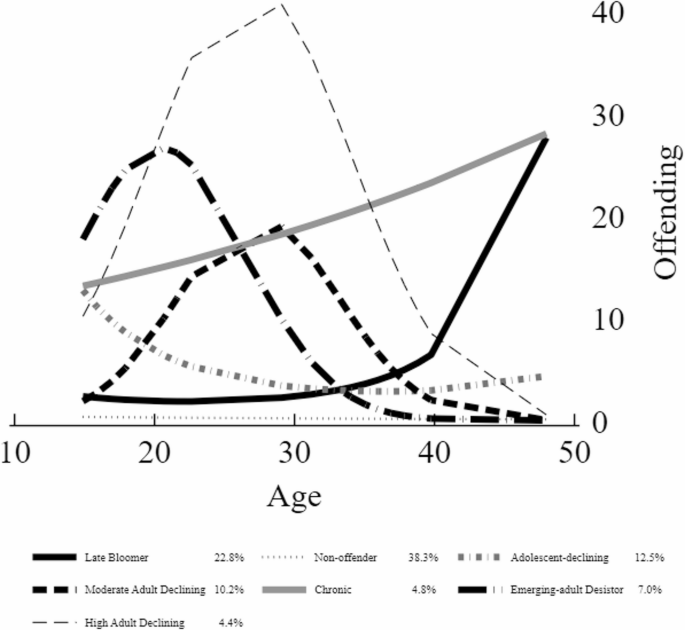
Patterns of offending spanning adolescence through adulthood (Avg. Age 14–48; N = 510)
Patterns of Offending and Individual ACEs
Table 1 presents descriptive information for the subset of RYDS participants for whom it was possible to examine the relationship between ACEs and patterns of offending (n = 510). Figure 2 reports the prevalence of ACEs among this analytic sample. The most common ACE reported by participants was having unmarried/separated/divorced parents (64%), followed by verbal abuse (50%), and no contact with at least one biological parent (35%). The least prevalent ACE was homelessness (9%). The remaining ACEs ranged in prevalence from 20 to 33%.

Frequency of Individual ACEs among RYDS Participants (N = 510)
Table 2 presents a summary of the multinomial logistic regression models regressing the hard-classified pattern of offending on each individual ACE, net of controls. Notably, living with someone who was depressed/mentally ill/suicidal or experiencing physical abuse did not distinguish between any patterns of offending. Alternatively, living with someone who engaged in illicit substance use or prescription drug abuse increased the relative risk of being hard-classified in any pattern of offending compared to the pattern of non-offending (RRR range: 2.56–6.17). Similarly, having a household member incarcerated was associated with a greater likelihood of being classified as chronic (RRR = 4.30, 95% CI [1.80–10.31.80.31])), late bloomer (RRR = 2.16, 95% CI [1.15–4.08]), high adult-declining (RRR = 3.21, 95% CI [1.11–9.29]), moderate adult-declining (RRR = 3.36, 95% CI [1.55–7.29]), or emerging-adult desistor (RRR = 3.60, 95% CI [1.50–8.65]) compared to the non-offending group, respectively.
Various other ACEs were also a risk factor for being classified into one of the patterns of offending relative to the non-offending pattern. For instance, having unmarried/separated/divorced parents increased the risk of following an adolescent-declining pattern of offending compared to non-offending (RRR = 1.93, 95% CI [1.04–3.61]) as well as increased the risk of following the pattern of chronic offending relative to non-offending (RRR = 2.34, 95% CI [1.01–5.42]). Not having contact with a biological parent also increased the likelihood of hard-classification into the chronic (RRR = 3.97, 95% CI [1.81–8.70]), late bloomer (RRR = 2.11, 95% CI [1.27–5.51]), and high adult-declining pattern of offending (RRR = 3.95, 95% CI [1.53–10.21]) relative to non-offending, respectively. Both exposure to IPV and experiencing sexual abuse also increased the likelihood of being classified into the chronic, late bloomer, emerging adult-desistor, and adolescent declining patterns of offending relative to non-offending. On the other hand, verbal abuse was only associated with an increased risk of classification as a late bloomer relative to non-offending (RRR = 2.420, 95% CI [1.483–3.950), and having an alcoholic in the household prior to age 18 was associated with an increased risk of being classified in the emerging-adult desistor (RRR = 3.055, 95% CI[1.415–6.596]) or moderate adult-declining (RRR = 2.209, 95% CI [1.130–4.322}) pattern of offending relative to non-offending.
Of particular interest is whether any individual ACEs distinguished between the risk of being classified into patterns that involved offending (i.e., not relative to the non-offending pattern). A few individual ACEs increased the relative risk of being classified into a pattern of chronic offending relative to a late bloomer pattern, including illicit substance use/prescription drug abuse in the household (RRR = 2.360, 95% CI [1.045–5.331]), sexual abuse (RRR = 2.866, 95% CI[1.177–6.979]), and homelessness (RRR = 3.391, 95% CI[1.192–9.645]). Sexual abuse (RRR = 2.656, 95% CI[1.013, 6.960]) and homelessness (RRR = 3.202, 95% CI[1.004–10.213]) were also associated with an increased relative risk of being classified into a chronic pattern of offending compared to an adolescent-declining pattern of offending. Finally, sexual abuse increased the relative risk of being classified into the pattern of chronic offending (RRR = 2.804, 95% CI[1.001–7.856]) relative to the moderate adult-declining pattern.
Patterns of Offending and Cumulative ACEs
The next set of analyses explored how the cumulative number of ACEs experienced were related to patterns of offending. With respect to the accumulation of ACEs, on average, the sample experienced 3 ACEs (SD = 2.843; see Table 1), with approximately 13% of the sample not experiencing any ACEs and 2% experiencing all 11 ACEs. Model 1 in Table 3 presents the results of the multinomial logistic regression model where patterns of offending were regressed upon the cumulative number of ACEs experienced, net of controls, with the non-offending pattern serving as the reference group. Each additional ACE experienced increased the relative risk of being classified into one of the patterns of offending, including adolescent-declining, emerging-adult desistors, moderate adult-declining, high adult-declining, late bloomer, and chronic offending, compared to a pattern of non-offending. However, the cumulative number of ACEs did not differentiate between any patterns where there was some evidence of offending spanning ages 14–48.Footnote 3
Patterns of Offending and ACEs in the Form of Threats and Deprivations
The final set of analyses examined how the accumulation of ACEs in the form of “threats” and “deprivations” were related to patterns of offending. Approximately 79% of the analytic sample experienced at least 1 “threat” in childhood, with an average of 2 threats experienced(\(\:\stackrel{-}{x}\)=2.192; sd = 2.111; see Table 1). Approximately 70% of the sample experienced at least one “deprivation,” with an average of 1 deprivation experienced (\(\:\stackrel{-}{x}\)=1.275; sd = 1.085; see Table 1). Model 2 in Table 3 presents the results of the multinomial logistic regression model where patterns of offending were regressed upon the cumulative number of “threats” and “deprivations”, net of controls, with the non-offending pattern of offending serving as the reference group. Notably, each additional threat was related to the increased relative risk of being classified into the pattern of adolescent-declining offending relative to non-offending (RRR = 1.207, 95% CI [1.026–1.421) or a late bloomer pattern of offending relative to non-offending (RRR = 1.166, 95% CI [1.017–1.360). Threats were unrelated to the relative risk of being classified in any other offending patterns relative to another.
Similarly, deprivations only distinguished between two patterns of offending and non-offending. Each additional deprivation nearly doubled the relative risk of being classified in the high adult-declining pattern of offending relative to non-offending (95% CI [1.208–3.291) and nearly doubled the risk of being classified in the chronic pattern of offending relative to non-offending (95% CI [1.293–2.954). Deprivations did not affect the relative risk of classification into any other patterns of offending.
Discussion
Relying upon the seminal work of Blumstein and colleagues (1988), research on the criminal career and its many manifestations (e.g., timing of onset, rate of offending, duration, etc.) have been pivotal to both theory and policy (McGee et al., 2021: p. 2; see also Piquero, 2021; Whitten et al., 2019). To be sure, this study did not reinvent the study of criminal careers. Instead, it drew upon the rich theoretical and methodological history of criminal career research to examine patterns of offending spanning adolescence through middle adulthood and examined whether it is possible to identify childhood and adolescent risk factors that can distinguish between these patterns of offending (see also Farrington et al., 2023). Unlike much prior work, this study relied upon prospective measures of self-reported offending instead of criminal justice contacts (i.e., arrests/convictions; Laub & Sampson 2006; Farrington et al., 2023) to better understand patterns of offending. Moreover, it used a common statistical approach – group based trajectory modeling (GBTM; Nagin, 2005; see also McGee et al., 2021) - to facilitate identification of general patterns of offending across age. Then, drawing upon the rich literature documenting the deleterious consequences of ACEs through middle adulthood (for a review, see Haczkewicz et al., 2024), it sought to determine whether these common targets for prevention and intervention (Centers for Disease Control, 2024), particularly with respect to physical and mental health outcomes, can further inform our understanding of criminal careers.
As a pioneer of GBTM, Nagin (2005; Nagin & Odgers, 2010) noted that the accumulation of additional data can and should be used to update previously identified groupings or patterns produced through GBTM (see also Farrington et al., 2023). This work built upon previous efforts (Bushway et al., 2013; Matsuda et al., 2022) and identified seven patterns that best represent the offending careers of RYDS participants to date. Similar to prior work with both RYDS and other longitudinal data sets (e.g., CSDD; Seattle Social Development Study; Glueck data), a pattern of non-offending was identified, and it was the modal pattern observed. Further, a pattern of offending labeled as “chronic” was identified, with elevated levels of offending spanning the entirety of adolescence and continuing through middle adulthood. Also consistent with prior work among the RYDS sample and others (Liu et al., 2022; Matsuda et al., 2022), a pattern of late blooming offending was observed with limited to non-existent offending in adolescence before increasing in frequency in early adulthood. Moreover, there is evidence of persistence and an increasing rate of offending through middle adulthood among this pattern of offending. The identification of this late-bloomer pattern as data on self-reported offending accrues through middle adulthood further confirms a distinct pattern of offending rather than a methodological artifact of criminal justice data (see also Matsuda et al., 2022). Further, the finding that, on average, this pattern evinces increased frequency in offending spanning early to middle adulthood challenges the arguments that adult-onset offending is unusual and “low rate” (Moffitt, 1993: 12) or the presupposition there is a decline in the crime rate with age among everyone (Gottfredson & Hirschi, 1990: 131). Theoretical arguments grounded in population heterogeneity have a difficult time accounting this pattern of offending, nor do they do well at similarly accounting for why a pattern of chronic offending similarly demonstrates an increasing frequency (on average) of offending through middle adulthood, as observed among this sample. Alternatively, theories that allow for notions of state dependence or transitions/turning points, which often are viewed as positive (e.g., Sampson & Laub, 1993; Giordano et al., 2003) but could similarly be negative in effect, hold more promise in explaining these identified developmental patterns of offending. Future research should further explore the nature of offenses among these patterns of offending as well the changing nature of risk profiles and meaningful life events (e.g., arrest, incarceration, unemployment, divorce) to further understand the circumstances under which the various developmental patterns of offending that involved elevated offending levels in middle adulthood may emerge.
Other patterns of offending also emerged in this study, with each providing some variation to the age-normative pattern of offending (Thornberry, 2005; Moffitt, 1993). These patterns of offending generally followed a course of increase, peak, and then decline to a point that is suggestive of potential desistance from offending thereafter. Notably, each of these patterns vary in terms of frequency and age at peak in offending, but they reinforce the notion that there is a subset of offenders who follow some variation of bell-curve shape in offending (McGee et al., 2021). Moreover, these identified patterns suggest that peaks in offending are shifting to later ages (early adulthood – late 20 s and 30 s) compared to previous generations (e.g., Laub & Sampson, 2003; Jolliffe et al., 2017), although this shift could also be an artifact of measurement (e.g., use of self-reported offending instead of criminal justice contacts). Future research should continue to explore whether more “normative” bell-shaped criminal careers may be shifting over time and across cohorts, as this can have serious implications for criminal justice resources.
A key finding to emerge from this effort is that ACEs are differentially related to the various patterns of offending, but their measurement is an important consideration. For example, the cumulative measure of ACEs distinguished between non-offenders and each of the other identified patterns of offending. This is similar to other work that has found ACEs distinguish between offenders and non-offenders using criminal justice contacts (e.g., Testa et al., 2022), and the accumulation of ACEs serves as a risk factor for offending, more generally. However, moving beyond a dichotomy of offenders and non-offenders, the number of ACEs were not able to distinguish between criminal careers that involved offending among the RYDS sample. Alternatively, individual ACEs seemed to hold more promise as risk factors that can be used to distinguish between patterns of offending, among those who offend.
From a theoretical and policy perspective, it is important to identify risk factors that can distinguish between patterns of offending in order to more efficiently allocate limited prevention and criminal justice resources, particularly during periods of fiscal constraint. To this end, policy makers may ask, “Who is most likely to persist in offending?” or “Who is most likely to desist/stop offending without intervention?”. ACEs in the form of sexual abuse and homelessness before the age of 18 both increased the relative risk of following a chronic pattern of offending relative to other patterns of offending, such as adolescent-declining, moderate adult-declining, and late bloomers. The psychological and physical consequences of sexual abuse on adolescent and adult functioning is well-documented (see De Jong et al., 2015), as is its relationship with subsequent victimization (e.g., Littleton et al., 2014). Further, childhood/adolescent sexual abuse is a particular snare that impedes human capital acquisition and economic well-being during adulthood (Henkhaus, 2022), which can promote persistent, elevated levels of offending.
Relatedly, many youth who experience sexual abuse often run away from home and/or have experienced bouts of homelessness, whether because homelessness increased the risk for subsequent sexual abuse or was a consequence of sexual abuse (e.g., Thrane and Yoder, 2011; Tyler et al., 2001). Youth homelessness is associated with an increased likelihood of psychological disorders, as well as drug and alcohol abuse (Martijn & Sharpe, 2006), all of which are more common among those who continue to offend through adulthood. Further, youth homelessness often serves as a barrier to human capital acquisition (e.g., limited schooling and failing to earn high school diploma), and, not surprisingly, it is associated with higher rates of unemployment in adulthood (Cobb-Clark & Zhu, 2017). As such, individuals who have experienced homelessness and/or sexual abuse as youth may find it difficult to experience turning points or hooks for change that can promote desistance (Laub & Sampson, 2003; Giordano et al., 2003), such as stable employment or prosocial partnerships, due to limited human capital acquisition and/or compromised mental and physical health. As such, greater investment into the prevention of sexual abuse and youth homelessness, as well as intervention efforts to reduce the proximal and distal consequences of sexual abuse and youth homelessness via support services, are needed because these contemporary investments have the potential to reduce the future economic and social burdens of crime (via victimization and criminal justice expenditures) in the future.
There remains a vocal debate within the field of criminology regarding whether late-bloomers or a late-onset pattern of offending is real or, rather, a methodological artifact (cf. Jolliffe et al., 2017). This study confirmed that the existence of this pattern of offending, and found that various ACEs (e.g., incarceration of parent, illicit substance use or prescription drug abuse in the household of origin, verbal abuse, witnessing IPV) increase the relative risk of following this pattern of offending compared to non-offending. However, the unique etiology and risk factors associated with this pattern of offending in relation to other patterns that involve offending remain limited. In all likelihood, the etiology for this pattern of offending involves a general level of risk that on its own is not enough to promote adolescent involvement in offending or is offset by experiences/characteristics in adolescence that serve as protective factors and inhibit offending. However, this initial risk may interact with (negative) experiences in emerging and early adulthood, such as unemployment, discrimination, or addiction, to promote later offending that continues to increase in frequency with age. Future research should build upon this investigation to explore how experiences in emerging and early adulthood may interact with ACEs to differentiate between the various patterns of offending in adulthood, particularly those that demonstrate various patterns of acceleration/deceleration during this period in the life course. In doing so, it may be possible to further identify adults in terms of risk-need-responsivity (Andrews & Bonta, 2014) to reduce recidivism and the overall costs of crime.
Interestingly, the categorization of ACEs as threats and deprivations in line with the DMAP perspective (Sheridan & McLaughlin, 2014) offered little insight into the relative risk for the various patterns of offending identified. Although in its infancy, the DMAP perspective relies heavily upon neurobiological consequences of adversities in childhood and adolescence to understand compromised development and subsequent deficits in functioning. However, this partitioning of adversity may be of little utility with respect to offending given that both compromised executive functioning (resulting from deprivations) and emotional dysregulation and compromised fear learning (resulting from threats) all play a role in the manifestation of crime and analogous risk behaviors (e.g., Wilson & Hernstein, 1985). Moreover, threats and deprivations do not occur in isolation and may trigger or elicit other ACEs (e.g., not having both parents in a household [deprivation] may undermine household stability and coincide or lead to mental health issues among the remaining parent [threat], physical abuse [threat], and/or homelessness [deprivation]). In fact, approximately 75% of the RYDS sample experienced both an ACE in the form of a threat and an ACE in the form of a deprivation. Therefore, there may not be an independent effect of threats or deprivations on offending behavior in terms of involvement, frequency, and duration. Instead, threats and deprivations may be more relevant to involvement in various types of offending (e.g., violent offending vs. property offending vs. drug sales). Future research should continue to explore the neurobiological underpinnings of the criminal career, and threats and deprivations may be one avenue to better understand the types of crimes selected by offenders.
Overall, this study confirms the importance of ACEs as risk factors for offending and the CDC’s call to further invest in and promote programming that stymie the prevalence and consequences of ACEs via economic and social support to families (e.g., tax credits and childcare subsidies, and low or no-cost substance abuse treatment) and opportunities to promote socio-emotional learning and resilience for children in safe environments (e.g., nurse-family partnerships and Big Brothers/Big Sisters of America; CDC, 2019). In doing so, at-risk and youth who have experienced ACEs can be connected to caring adults who will help provide safe, stable, and nurturing relationships, which are known to offset the adverse effects of ACEs (e.g., Crouch et al., 2019b; CDC, 2019). Further, the investment in these programs today, particularly programs that serve youth who have experienced sexual abuse or homelessness, may result in decreased criminal justice expenditures down the road.
As with all research, this study is not limitations that impact the conclusions that can be drawn from this work. RYDS prospectively follows an cohort originating from one city in the United States. As such, there are potential limitations with respect to the generalizeability of the findings, as well as the use of a subset of the original participants to study the relationship between ACEs and patterns of offending. Nonetheless, this work confirms prior work that identifies various (similar) patterns of offending through middle adulthood and the relevance of ACEs with respect to offending. Further, it attempted to provide more nuance and dimension to other work, which has primarily relied upon criminal justice contacts, by estimating these patterns of offending with self-report data and examining the relationship between ACEs and self-reported offending. Moreover, the method utilized – GBTM – is not without its own limitations (see Nagin & Odgers, 2010), particularly those with respect to the study of criminal careers (McGee et al., 2021). The names and meanings given to the various patterns of offending were selected by the authors, so there is an element of subjectivity. Further, there is likely much variation and deviation from the seven patterns that were observed statistically. As such, the findings should not be interpreted as offenders following these patterns in lock-step or that reified group exist. Instead, the groupings should be viewed as general patterns whereby offenders show more similarity in behavior to some compared to other others and as such are hard classified into a group for analytical purposes. Finally, while offending behavior was prospectively reported in RYDS, ACEs were retrospectively reported when the participants were in their mid to late 40s. In all likelihood, some may have forgotten or not been aware of the adversities experienced childhood, particularly at very young ages. Alternatively, some may not have wanted to report/recall their traumatic experiences. As such, it is quite possible those who were included in this investigation versus those who were not (skipped answering/dropped out/lost to the study/deceased) vary in experiences of ACEs. This should also provide some caution with respect to the generalizeability of the findings.
Criminological theory and criminal justice policy have been fortified by the study of crime over the life course and the acknowledgement of various aspects of the criminal career. As both efforts continue to move forward with the similar goals of understanding and preventing/reducing crime, prospective, longitudinal studies will continue to buttress these efforts through the identification of general patterns of criminal careers as well as risk/protective factors associated with these patterns. More so, the value of these studies lies in their ability to further explore timing in lives, snares, cumulative consequences, turning points, hooks for change, and identity shifts that underscore criminological theory, give shape to patterns of offending, and serve as targets for prevention and intervention as well as criminal justice services.
Data Availability
Phase 1 of the Rochester Youth Development Study (RYDS) and the Rochester Intergenerational Study (RIGS) Years 1-20 are available from the National Archive of Criminal Justice Data. All RYDS and RIGS data are available by application from the PI and data manager.
Notes
Data collection was approved by the University of Albany IRB (05-419); the current project was approved by Florida State University IRB (00004371). Parental consent/Primary caregiver was obtained (signature) before youths were contacted for participation and informed consent. Youths had to give verbal consent and sign as well.
Exploratory factor analyses were conducted to determine whether two factors emerged in line with the constructs of “threats” and “deprivations” as proposed by McLaughlin et al. (2014). Only one factor emerged that contained all 11 ACEs. However, given the biological arguments regarding the varying consequences of ACEs, the two constructs were retained even though they represent a larger construct of “adversity”. The Pearson correlation coefficient between these two measures indicated a moderate relationship (r =.49).
This pattern of results were replicated when using a threshold measure of cumulative ACEs. Experiencing 4 or more ACEs increased the relative risk of being classified into the adolescent-declining, emerging-adult desistor, moderate adult-declining, high adult-declining, late bloomer, and chronic offending pattern compared to a pattern of non-offending. This threshold measure did not distinguish between any other patterns of offending.
References
Andrews, D. A., & Bonta, J. (2014). The psychology of criminal conduct. Routledge.
Awada, S. R., Shelleby, E. C., Alfonso, D., & Keane, J. (2025). Differential mechanisms linking early childhood threat and social/environmental deprivation to adolescent conduct problems. Journal of Family Violence, 40(3), 541–553.
Backes, E. P., & Bonnie, R. J. (2019). & National Academies of Sciences, Engineering, and Medicine. Adolescent Development. In The Promise of Adolescence: Realizing Opportunity for All Youth. National Academies Press (US).
Baglivio, M. T., Wolff, K. T., Piquero, A. R., & Epps, N. (2015). The relationship between adverse childhood experiences (ACE) and juvenile offending trajectories in a juvenile offender sample. Journal of Criminal Justice, 43(3), 229–241.
Bergeron, T. K., & Valliant, P. M. (2001). Executive function and personality in adolescent and adult offenders vs. non-offenders. Journal of Offender Rehabilitation, 33(3), 27–45.
Bersani, B. E., & Doherty, E. E. (2018). Desistance from offending in the twenty-first century. Annual Review of Criminology, 1(1), 311–334.
Blodgett, C., & Lanigan, J. D. (2018). The association between adverse childhood experience (ACE) and school success in elementary school children. School Psychology Quarterly, 33(1), 137.
Blokland, A. A., & Nieuwbeerta, P. (2005). The effects of life circumstances on longitudinal trajectories of offending. Criminology, 43(4), 1203–1240.
Blumstein, A., & Cohen, J. (1987). Characterizing criminal careers. Science, 237(4818), 985–991.
Blumstein, A., Cohen, J., & Farrington, D. P. (1988). Criminal career research: Its value for criminology. Criminology, 26(1), 1–35.
Boccio, C. M., Meldrum, R. C., & Jackson, D. B. (2022). Adverse childhood experiences and adolescent nicotine and marijuana vaping: Findings from a statewide sample of Florida youth. Preventive Medicine, 154, Article 106866.
Bushway, S. D., & Paternoster, R. (2013). Identity and desistance from crime. Effective interventions in the lives of criminal offenders (pp. 63–77). Springer New York.
Bushway, S. D., Krohn, M. D., Lizotte, A. J., Phillips, M. D., & Schmidt, N. M. (2013). Are risky youth less protectable as they age? The dynamics of protection during adolescence and young adulthood. Justice quarterly, 30(1), 84–116.
Busso, D. S., McLaughlin, K. A., & Sheridan, M. A. (2017). Dimensions of adversity, physiological reactivity, and externalizing psychopathology in adolescence: Deprivation and threat. Biopsychosocial Science and Medicine, 79(2), 162–171.
Center for the Developing Child. (2018). Aces and toxic stress: Frequently Asked Questions. Havard University. Available online at https://developingchild.harvard.edu/resources/infographics/aces-and-toxic-stress-frequently-asked-questions/
Centers for Disease Control (CDC). (2019). Preventing adverse childhood experienes (ACEs) to improve U.S. health. Available online athttps://archive.cdc.gov/www_cdc_gov/media/releases/2019/p1105-prevent-aces.html
Centers for Disease Control (CDC). (2024). About adverse childhood experiences (ACEs). Available online at https://www.cdc.gov/aces/about/index.html
Centers for Disease Control and Prevention (CDC). (2009). Behavioral risk factor surveillance system survey data. U.S. Department of Health and Human Services.
Cobb-Clark, D. A., & Zhu, A. (2017). Childhood homelessness and adult employment: The role of education, incarceration, and welfare receipt. Journal of Population Economics, 30(3), 893–924.
Cohen, M. A., Piquero, A. R., & Jennings, W. G. (2010). Studying the costs of crime across offender trajectories. Criminology & Public Policy, 9(2), 279–305.
Craig, J. M., Piquero, A. R., Farrington, D. P., & Ttofi, M. M. (2017). A little early risk goes a long bad way: Adverse childhood experiences and life-course offending in the Cambridge study. Journal of Criminal Justice, 53, 34–45.
Crouch, E., Probst, J. C., Radcliff, E., Bennett, K. J., & McKinney, S. H. (2019a). Prevalence of adverse childhood experiences (ACEs) among US children. Child Abuse & Neglect, 92, 209–218.
Crouch, E., Radcliff, E., Strompolis, M., & Srivastav, A. (2019b). Safe, stable, and nurtured: Protective factors against poor physical and mental health outcomes following exposure to adverse childhood experiences (ACEs). Journal of child & adolescent trauma, 12(2), 165–173.
Cullen, F. T. (2011). Beyond adolescence-limited criminology: Choosing our future—the American Society of Criminology 2010 Sutherland address. Criminology, 49(2), 287–330.
De Jong, R., Alink, L., Bijleveld, C., Finkenauer, C., & Hendriks, J. (2015). Transition to adulthood of child sexual abuse victims. Aggression and Violent Behavior, 24, 175–187.
Desch, J., Mansuri, F., Tran, D., Schwartz, S. W., & Bakour, C. (2023). The association between adverse childhood experiences and depression trajectories in the Add Health study. Child Abuse & Neglect, 137, Article 106034.
Dube, S. R., Anda, R. F., Felitti, V. J., Croft, J. B., Edwards, V. J., & Giles, W. H. (2001). Growing up with parental alcohol abuse: Exposure to childhood abuse, neglect, and household dysfunction. Child Abuse & Neglect, 25(12), 1627–1640.
Elkins, J., Miller, K. M., Briggs, H. E., Kim, I., Mowbray, O., & Orellana, E. R. (2019). Associations between adverse childhood experiences, major depressive episode and chronic physical health in adolescents: Moderation of race/ethnicity. Social Work in Public Health, 34(5), 444–456.
Evans, G. W., Li, D., & Whipple, S. S. (2013). Cumulative risk and child development. Psychological Bulletin, 139(6), 1342.
Eysenck, H. J. (1976). The learning theory model of neurosis—a new approach. Behaviour Research and Therapy, 14(4), 251–267.
Fagan, A. A., & Novak, A. (2018). Adverse childhood experiences and adolescent delinquency in a high-risk sample: A comparison of white and black youth. Youth Violence and Juvenile Justice, 16(4), 395–417.
Farnworth, M., Thornberry, T. P., Lizotte, A. J., & Krohn, M. D. (1990). Technical Report No. 1: Sampling Design and Implementation. Rochester Youth Development Study.
Farrington, D. P., Gaffney, H., & Ttofi, M. M. (2017). Systematic reviews of explanatory risk factors for violence, offending, and delinquency. Aggression and Violent Behavior, 33, 24–36.
Farrington, D. P., Piquero, A. R., Jennings, W. G., & Jolliffe, D. (2023). Offending from childhood to late middle age: Recent results from the Cambridge study in delinquent development. Springer Nature.
Felitti, V. J., Anda, R. F., Nordenberg, D., Williamson, D. F., Spitz, A. M., Edwards, V., & Marks, J. S. (1998). Relationship of childhood abuse and household dysfunction to many of the leading causes of death in adults: The Adverse Childhood Experiences (ACE) Study. American Journal of Preventive Medicine, 14(4), 245–258.
Fewtrell, M. S., Kennedy, K., Singhal, A., Martin, R. M., Ness, A., Hadders-Algra, M., & Lucas, A. (2008). How much loss to follow-up is acceptable in long-term randomised trials and prospective studies? Archives of Disease in Childhood, 93(6), 458–461.
Freeze, C. (2019). Adverse childhood experiences and crime. FBI Law Enforcement Bulletin, 1–7.
Gibson, C. L., & Krohn, M. D. (Eds.). (2012). Handbook of life-course criminology: Emerging trends and directions for future research. Springer.
Giordano, P. C., Cernkovich, S. A., & Holland, D. D. (2003). Changes in friendship relations over the life course: Implications for desistance from crime. Criminology, 41(2), 293–328.
Godoy, L. C., Frankfurter, C., Cooper, M., Lay, C., Maunder, R., & Farkouh, M. E. (2021). Association of adverse childhood experiences with cardiovascular disease later in life: A review. JAMA Cardiology, 6(2), 228–235.
Gottfredson, M. R., & Hirschi, T. (1990). A general theory of crime. Stanford University Press.
Griffith, R. L., Nowalis, S., & Monroe-Gulick, A. (2024). Executive functioning and offending behavior: An updated meta-analysis. Criminal Justice and Behavior, 51(4), 528–551.
Gupta, S. (2022). First-time exploration of adverse childhood experiences among adults in Delaware using BRFSS data: A cross-sectional study. Public Health in Practice, 3, 100233.
Haczkewicz, K. M., Shahid, S., Finnegan, H. A., Monnin, C., Cameron, C. D., & Gallant, N. L. (2024). Adverse childhood experiences (ACEs), resilience, and outcomes in older adulthood: A scoping review. Child Abuse & Neglect, 168(1), 1–17.
Hanna, K. M., Scott, L. L., & Schmidt, K. K. (2014). Retention strategies in longitudinal studies with emerging adults. Clinical Nurse Specialist, 28(1), 41–45.
Hansen, C. D., Kirkeby, M. J., Kjelmann, K. G., Andersen, J. H., & Møberg, R. J. (2021). The importance of adverse childhood experiences for labour market trajectories over the life course: A longitudinal study. BMC Public Health, 21(1), Article 2044.
Henkhaus, L. E. (2022). The lasting consequences of childhood sexual abuse on human capital and economic well-being. Health Economics, 31(9), 1954–1972.
Howell, J. C., & EgleyJr, A. (2005). Moving risk factors into developmental theories of gang membership. Youth Violence and Juvenile Justice, 3(4), 334–354.
Huizinga, D., & Elliott, D. S. (1986). Reassessing the reliability and validity of self-report delinquency measures. Journal of Quantitative Criminology, 2(4), 293–327.
Jackson, D. B., Testa, A., & Vaughn, M. G. (2021). Adverse childhood experiences and school readiness among preschool-aged children. The Journal of Pediatrics, 230, 191–197.
Jolliffe, D., Farrington, D. P., Piquero, A. R., Loeber, R., & Hill, K. G. (2017). Systematic review of early risk factors for life-course-persistent, adolescence-limited, and late-onset offenders in prospective longitudinal studies. Aggression and Violent Behavior, 33, 15–23.
Kerridge, B. T., Chou, S. P., Huang, B., & Harford, T. C. (2020). Sociodemographic characteristics, adverse childhood experiences, and substance use and psychiatric disorders among adolescent-limited, adult-onset, life-course-persistent offenders and nonoffenders in a general population survey. Crime & Delinquency, 66(12), 1729–1753.
Kim, Y. H. (2017). Associations of adverse childhood experiences with depression and alcohol abuse among Korean college students. Child Abuse & Neglect, 67, 338–348.
Kirk, D. S. (2017). Residential change as a turning point in the life course of crime: Desistance or temporary cessation? Developmental and Life-course Criminological Theories (pp. 231–259). Routledge.
Kisling, L. A., & Das, J. M. (2023). Prevention strategies. In StatPearls [internet]. StatPearls Publishing. Available online at https://www.ncbi.nlm.nih.gov/books/NBK537222/
Krohn, M. D., Gibson, C. L., & Thornberry, T. P. (2012). Under the protective bud the bloom awaits: A review of theory and research on adult-onset and late-blooming offenders. Handbook of life-course criminology: Emerging trends and directions for future research, 183–200.
Lambert, H. K., King, K. M., Monahan, K. C., & McLaughlin, K. A. (2017). Differential associations of threat and deprivation with emotion regulation and cognitive control in adolescence. Development and Psychopathology, 29(3), 929–940.
Laub, J. H., & Sampson, R. J. (1993). Turning points in the life course: Why change matters to the study of crime. Criminology, 31(3), 301–325.
Laub, J. H., & Sampson, R. J. (2006). Shared beginnings, divergent lives: Delinquent boys to age 70. Harvard University Press.
Leban, L., & Gibson, C. L. (2020). The role of gender in the relationship between adverse childhood experiences and delinquency and substance use in adolescence. Journal of Criminal Justice, 66, Article 101637.
Lee, R. D., & Chen, J. (2017). Adverse childhood experiences, mental health, and excessive alcohol use: Examination of race/ethnicity and sex differences. Child Abuse & Neglect, 69, 40–48.
Lee, R. Y., Oxford, M. L., Sonney, J., Enquobahrie, D. A., & Cato, K. D. (2022). The mediating role of anxiety/depression symptoms between adverse childhood experiences (ACEs) and somatic symptoms in adolescents. Journal of Adolescence, 94(2), 133–147.
Littleton, H. L., Grills, A. E., & Drum, K. B. (2014). Predicting risky sexual behavior in emerging adulthood: Examination of a moderated mediation model among child sexual abuse and adult sexual assault victims. Violence & Victims. https://doi.org/10.1891/0886-6708.vv-d-13-00067
Liu, L., Visher, C. A., & O’Connell, D. J. (2022). Late-bloomers among US offenders: A test using a 30-year longitudinal study. Journal of Developmental and Life-Course Criminology, 8(4), 547–570.
Martijn, C., & Sharpe, L. (2006). Pathways to youth homelessness. Social Science & Medicine, 62(1), 1–12.
Matsuda, M., Thornberry, T. P., Loughran, T. A., & Krohn, M. D. (2022). Are late bloomers real? Identification and comparison of late-onset offending patterns from ages 14–40. Journal of Developmental and Life-Course Criminology, 8(1), 124–150.
McEwen, B. S. (2017). Neurobiological and systemic effects of chronic stress. Chronic Stress, 1, Article 2470547017692328.
McGee, T. R., Whitten, T., Williams, C., Jolliffe, D., & Farrington, D. P. (2021). Classification of patterns of offending in developmental and life-course criminology, with special reference to persistence. Aggression and Violent Behavior, 59, Article 101460.
McLaughlin, K. A., Peverill, M., Gold, A. L., Alves, S., & Sheridan, M. A. (2015). Child maltreatment and neural systems underlying emotion regulation. Journal of the American Academy of Child and Adolescent Psychiatry, 54(9), 753–762.
McLaughlin, K. A., & Sheridan, M. A. (2016). Beyond cumulative risk: A dimensional approach to childhood adversity. Current Directions in Psychological Science, 25(4), 239–245.
McLaughlin, K. A., Sheridan, M. A., & Lambert, H. K. (2014). Childhood adversity and neural development: Deprivation and threat as distinct dimensions of early experience. Neuroscience and Biobehavioral Reviews, 47, 578–591.
Mears, D. P., & Siennick, S. E. (2016). Young adult outcomes and the life-course penalties of parental incarceration. Journal of Research in Crime and Delinquency, 53(1), 3–35.
Miller, M. A., & Marsee, M. A. (2019). Emotional reactivity and antisocial behavior relative to posttraumatic stress symptom expression: A latent profi le analysis. Journal of abnormal child psychology, 47(8), 1339–1350.
Moffitt, T. E. (1993). Adolescence-limited and life-course-persistent antisocial behavior: A developmental taxonomy. Psychological Review, 100, 674–701.
Monnat, S. M., & Chandler, R. F. (2015). Long-term physical health consequences of adverse childhood experiences. Sociological Quarterly, 56(4), 723–752.
Morrow, A. S., & Villodas, M. T. (2018). Direct and indirect pathways from adverse childhood experiences to high school dropout among high-risk adolescents. Journal of Research on Adolescence, 28(2), 327–341.
Muthén, B., & Muthén, L. K. (2000). Integrating person-centered and variable‐centered analyses: Growth mixture modeling with latent trajectory classes. Alcoholism, Clinical and Experimental Research, 24(6), 882–891.
Nagin, D. S. (2005). Group-based Modeling of Development. Harvard University Press.
Nagin, D. S., & Land, K. C. (1993). Age, criminal careers, and population heterogeneity: Specification and estimation of a nonparametric, mixed Poisson model. Criminology, 31(3), 327–362.
Nagin, D. S., & Odgers, C. L. (2010). Group-based trajectory modeling (nearly)two decades later. Journal of quantitative criminology, 26(4), 445–453.
Nagin, D. S., & Piquero, A. R. (2010). Using the group-based trajectory model to study crime over the life course. Journal of Criminal Justice Education, 21(2), 105–116.
Nagin, D., & Paternoster, R. (2000). Population heterogeneity and state dependence: State of the evidence and directions for future research. Journal of Quantitative Criminology, 16(2), 117–144.
Odom, S. L., Hanson, M., Lieber, J., Diamond, K., Palmer, S., Butera, G., & Horn, E. (2012). Prevention, early childhood intervention, and implementation science. Handbook of Youth Prevention Science (pp. 413–432). Routledge.
Paternoster, R., & Bushway, S. (2009). Desistance and the feared self: Toward an identity theory of criminal desistance. The Journal of Criminal Law and Criminology, 1103–1156.
Paternoster, R., Bachman, R., Bushway, S., Kerrison, E., & O’Connell, D. (2015). Human agency and explanations of criminal desistance: Arguments for a rational choice theory. Journal of Developmental and Life-Course Criminology, 1(3), 209–235.
Piquero, A. R. (2021). The life-course of a Life-Course Criminologist: The David P. Farrington lecture for the division on developmental and life-course criminology lifetime achievement award address 2020. Journal of Developmental and Life-Course Criminology, 7(3), 297–307.
Poulton, R., Guiney, H., Ramrakha, S., & Moffitt, T. E. (2023). The Dunedin study after half a century: Reflections on the past, and course for the future. Journal of the Royal Society of New Zealand, 53(4), 446–465.
Poulton, R., Moffitt, T. E., & Silva, P. A. (2015). The Dunedin multidisciplinary health and development study: Overview of the first 40 years, with an eye to the future. Social Psychiatry and Psychiatric Epidemiology, 50(5), 679–693.
Reckdenwald, A., Mancini, C., & Beauregard, E. (2013). The cycle of violence: Examining the impact of maltreatment early in life on adult offending. Violence & Victims. https://doi.org/10.1891/0886-6708.vv-d-12-00054
Richter, L., Black, M., Britto, P., Daelmans, B., Desmond, C., Devercelli, A., Dua, T., Fink, G., Heymann, J., Lombardi, J., Lu, C., Naicker, S., & Vargas-Barón, E. (2019). Early childhood development: An imperative for action and measurement at scale. BMJ Global Health. https://doi.org/10.1136/bmjgh-2018-001302
Roberton, T., Daffern, M., & Bucks, R. S. (2014). Maladaptive emotion regulation and aggression in adult offenders. Psychology, Crime & Law, 20(10), 933–954.
Roeder, K., Lynch, K. G., & Nagin, D. S. (1999). Modeling uncertainty in latent class membership: A case study in criminology. Journal of the American Statistical Association, 94(447), 766–776.
Sachs-Ericsson, N. J., Sheffler, J. L., Stanley, I. H., Piazza, J. R., & Preacher, K. J. (2017). When emotional pain becomes physical: Adverse childhood experiences, pain, and the role of mood and anxiety disorders. Journal of Clinical Psychology, 73(10), 1403–1428.
Sampson, R. J., & Laub, J. H. (2003). Desistance from crime over the life course. Handbook of the Life Course (pp. 295–309). Springer US.
Sampson, R. J., & Laub, J. H. (2017). A life-course view of the development of crime. Developmental and Life-course Criminological Theories (pp. 329–362). Routledge.
Sampson, R. J., Laub, J. H., & Wimer, C. (2006). Does marriage reduce crime? A counterfactual approach to within-individual causal effects. Criminology, 44(3), 465–508.
Sheridan, M. A., & McLaughlin, K. A. (2014). Dimensions of early experience and neural development: Deprivation and threat. Trends in Cognitive Sciences, 18(11), 580–585.
Skardhamar, T. (2010). Distinguishing facts and artifacts in group-based modeling. Criminology, 48(1), 295–320.
StataCorp. (2021). Stata: Release 17. Statistical software. StataCorp LLC.
Swedo, E. A. (2023). Prevalence of adverse childhood experiences among US adults—behavioral risk factor surveillance system, 2011–2020. MMWR. Morbidity and Mortality Weekly Report. https://doi.org/10.15585/mmwr.mm7226a2
Tärnhäll, A., Björk, J., Wallinius, M., Gustafsson, P., & Hofvander, B. (2023). Offending trajectories in violent offenders: Criminal history and early life risk factors. International Journal of Offender Therapy and Comparative Criminology, 67(2–3), 270–290.
Testa, A., Jackson, D. B., Ganson, K. T., & Nagata, J. M. (2022). Adverse childhood experiences and criminal justice contact in adulthood. Academic Pediatrics, 22(6), 972–980.
Thomas, K. J., & Vogel, M. (2019). Testing a rational choice model of “desistance: ” Decomposing changing expectations and changing utilities. Criminology, 57(4), 687–714.
Thornberry, T. P. (2005). Explaining multiple patterns of offending across the life course and across generations. The Annals of the American Academy of Political and Social Science, 602(1), 156–195.
Thornberry, T. P., Henry, K. L., Krohn, M. D., Lizotte, A. J., & Nadel, E. L. (2018). Key findings from the Rochester intergenerational study. Intergenerational continuity of criminal and antisocial behaviour (pp. 214–234). Routledge.
Thrane, L. E., & Yoder, K. A. (2011). The influence of running away on the risk of female sexual assault in the subsequent year. Violence & Victims. https://doi.org/10.1891/0886-6708.26.6.816
Tyler, K. A., Hoyt, D. R., Whitbeck, L. B., & Cauce, A. M. (2001). The impact of childhood sexual abuse on later sexual victimization among runaway youth. Journal of Research on Adolescence, 11(2), 151–176.
Whitten, T., McGee, T. R., Homel, R., Farrington, D. P., & Ttofi, M. (2019). Comparing the criminal careers and childhood risk factors of persistent, chronic, and persistent–chronic offenders. Australian & New Zealand Journal of Criminology, 52(2), 151–173.
Wilson, J. Q., & Herrnstein, R. J. (1985). Crime human nature: The definitive study of the causes of crime. Free.
Zou, Z., Meng, H., Ma, Z., Deng, W., Du, L., Wang, H., & Hu, H. (2013). Executive functioning deficits and childhood trauma in juvenile violent offenders in China. Psychiatry Research, 207(3), 218–224.
Funding
Support for the Rochester Youth Development Study has been provided by the National Institute of Justice (NIJ-2020-MUMU-0075; 15PNIJ-23-AG-01491-MUMU), National Institute on Drug Abuse (R01DA020195, R01DA005512), the Office of Juvenile Justice and Delinquency Prevention (86-JN-CX-0007, 96-MU-FX-0014, 2004-MU-FX-0062), the National Science Foundation (SBR-9123299), and the National Institute of Mental Health (R01MH56486, R01MH63386). Technical assistance for this project was also provided by an NICHD grant (R24HD044943) to The Center for Social and Demographic Analysis at the University at Albany. Points of view or opinions in this document are those of the authors and do not necessarily represent the official position or policies of the funding agencies.
Author information
Authors and Affiliations
Contributions
MBA came up with the research idea, performed all data cleaning and analyses, and wrote the Data, Methods, Results, and Discussion. EH conferred with MBA on measurement and model selection and wrote the Introduction and Literature Review. Both authors reviewed the final manuscript and contributed to revisions.
Corresponding author
Ethics declarations
Competing Interests
The authors declare no competing interests.
Additional information
Publisher’s Note
Springer Nature remains neutral with regard to jurisdictional claims in published maps and institutional affiliations.
Appendix
Appendix
Rights and permissions
Springer Nature or its licensor (e.g. a society or other partner) holds exclusive rights to this article under a publishing agreement with the author(s) or other rightsholder(s); author self-archiving of the accepted manuscript version of this article is solely governed by the terms of such publishing agreement and applicable law.
About this article

Cite this article
Augustyn, M., Hargrove, E. “There Are Patterns To life…”: Adverse Childhood Experiences and Adolescent To Middle Adulthood Patterns of Self-Reported Offending. J Dev Life Course Criminology 12, 4 (2026). https://doi.org/10.1007/s40865-026-00294-z
Received:
Revised:
Accepted:
Published:
Version of record:
DOI: https://doi.org/10.1007/s40865-026-00294-z