Why is Trump threatening Venezuela's Maduro?

- Published
US President Donald Trump has been ramping up pressure on Venezuela's leader, President Nicolás Maduro.
In a sharp escalation of Washington's campaign on 10 December, the US seized a tanker off Venezuela's coast, accusing it of transporting sanctioned oil.
US warships are within striking distance of the South American country and dozens of people have been killed in attacks on boats alleged to have been carrying drugs.
The Trump administration has also doubled the reward for information leading to Maduro's capture.
Who is Nicolás Maduro?

Nicolás Maduro rose to prominence under the leadership of left-wing President Hugo Chávez and his United Socialist Party of Venezuela (PSUV).
Maduro, a former bus driver and union leader, succeeded Chávez and has been president since 2013.
During the 26 years that Chávez and Maduro have been in power, their party has gained control of key institutions including the National Assembly, much of the judiciary, and the electoral council.
In 2024, Maduro was declared winner of the presidential election, even though voting tallies collected by the opposition suggested that their candidate, Edmundo González, had won by a landslide.
González had replaced the main opposition leader, María Corina Machado, on the ballot after she was barred from running for office.
She was awarded the Novel Peace Prize in October for "her struggle to achieve a just and peaceful transition from dictatorship to democracy".
Machado defied a travel ban and made her way to Oslo in December to collect the award after months in hiding.
What we know about US seizure of oil tanker off Venezuela
- Published1 hour ago
Venezuelan Nobel winner emerges to collect prize in Oslo after months in hiding
- Published4 hours ago
Nicolás Maduro: The leader who promised to win 'by hook or by crook'
- Published24 July 2024
Why is Trump focusing on Venezuela?
Trump blames Maduro for the arrival of hundreds of thousands of Venezuelan migrants in the US.
They are among close to eight million Venezuelans estimated to have fled the country's economic crisis and repression since 2013.
Without providing evidence, Trump has accused Maduro of "emptying his prisons and insane asylums" and "forcing" its inmates to migrate to the US.
Trump has also focused on fighting the influx of drugs - especially fentanyl and cocaine - into the US.
He has designated two Venezuelan criminal groups - Tren de Aragua and Cartel de los Soles - as Foreign Terrorist Organisations and has alleged that the latter is led by Maduro himself.
Maduro has vehemently denied being a cartel leader and has accused the US of using its "war on drugs" as an excuse to try and depose him and get its hands on Venezuela's vast reserves of oil.
Analysts have pointed out that Cartel de los Soles is not a hierarchical group but a term used to describe corrupt officials who have allowed cocaine to transit through Venezuela.
Why has the US sent warships to the Caribbean?

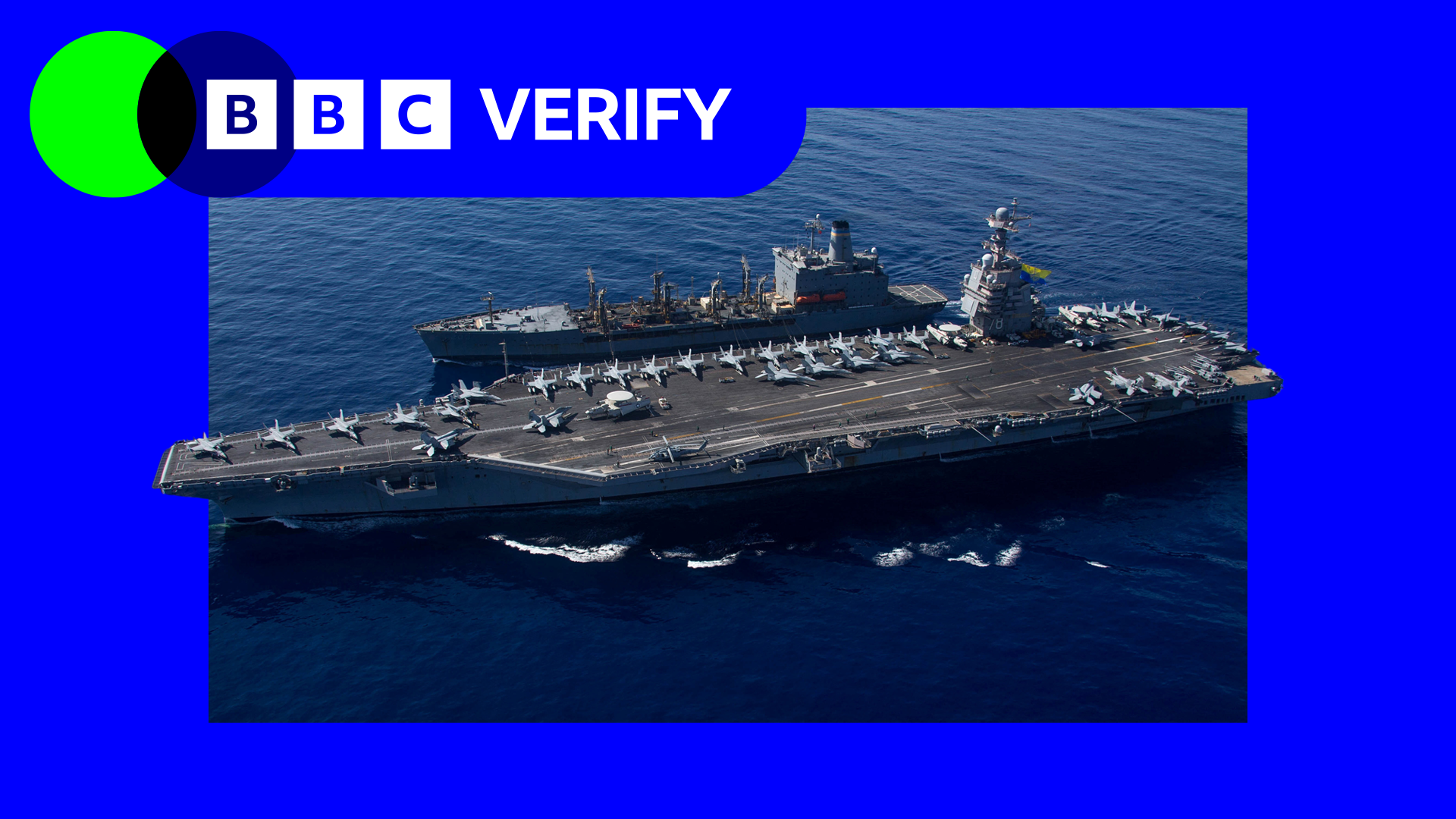
The USS Gerald Ford is among the ships deployed to the Caribbean, and was the springboard when the US seized an oil tanker off the Venezuelan coast
The US has deployed 15,000 troops and a range of aircraft carriers, guided-missile destroyers, and amphibious assault ships to the Caribbean.
The stated aim of the deployment - the largest to the region since the US invaded Panama in 1989 - is to stop the flow of fentanyl and cocaine to the US.
Among the ships is the USS Gerald Ford, the world's largest aircraft carrier. US helicopters reportedly took off from it before the oil tanker was seized off Venezuela.
The US said the tanker had been "used to transport sanctioned oil from Venezuela and Iran". Venezuela described the action as an act of "international piracy".
US seizes oil tanker off Venezuela as Caracas condemns 'act of piracy'
- Published45 minutes ago
In recent months, US forces have also carried out more than 20 strikes in international waters on boats alleged to have been carrying drugs. More than 80 people have been killed.
The Trump administration argues that it is involved in a non-international armed conflict with the alleged drug traffickers, whom it accuses of conducting irregular warfare against the US.
The US has also described those on board as "narco terrorists", but legal experts say the strikes are not against "lawful military targets". The first attack - on 2 September - has drawn particular scrutiny as there was not one but two strikes, with survivors of the first hit killed in the second.
A former chief prosecutor at the International Criminal Court told the BBC that the US military campaign more generally fell into the category of a planned, systematic attack against civilians during peacetime.
In response, the White House said it had acted in line with the laws of armed conflict to protect the US from cartels "trying to bring poison to our shores... destroying American lives".
How the White House account of September boat strike has evolved
- Published5 days ago
Is Venezuela flooding the US with drugs?
Counternarcotic experts say that Venezuela is a relatively minor player in global drug trafficking, acting as a transit country through which drugs produced elsewhere are smuggled.
Its neighbour, Colombia, is the world's largest producer of cocaine but most of it is smuggled to the US by other routes, not via Venezuela.
According to a US Drug Enforcement Administration report from 2020, almost three quarters of the cocaine reaching the US is estimated to be trafficked via the Pacific with just a small percentage coming via fast boats in the Caribbean.
Nevertheless, most of the strikes the US has carried out have been in the Caribbean, with just a few in the Pacific.
In September, Trump told US military leaders that the boats targeted "are stacked up with bags of white powder that's mostly fentanyl and other drugs, too".
Fentanyl is a synthetic drug which is 50 times more potent than heroin and has become the main drug responsible for opioid overdose deaths in the US.
However, fentanyl is produced mainly in Mexico and reaches the US almost exclusively via land through its southern border.
Venezuela is not mentioned as a country of origin for fentanyl smuggled into the US in the US Drug Enforcement Administration's 2025 National Drug Threat Assessment, external.
How much oil does Venezuela export, and who buys it?
Oil is the Maduro government's main source of foreign revenue, with profits from the sector financing more than half of the government's budget.
It currently exports about 900,000 barrels per day. China is by far its biggest buyer.
However, although a US assessment suggests Venezuela has the world's largest proven crude oil reserves, it says that it does relatively little with them.
Venezuela produced only 0.8% of global crude oil in 2023, according to the US Energy Information Administration (EIA), due to technical and budgetary challenges.
After announcing that the tanker had been seized, Trump told reporters: "I assume we're going to keep the oil."
The US has previously denied Venezuela's allegations that moves against Maduro's government were an attempt to secure access to the country's untapped reserves.
Could the US carry out strikes on Venezuela?
Trump has confirmed that he spoke to Maduro on the phone on 21 November.
While he did not reveal what was said in the call, Reuters news agency reported that Trump gave Maduro a one-week ultimatum to leave Venezuela along with his close family. It said that Maduro did not take him up on the offer of safe passage.
One day after the deadline expired, Trump declared the airspace around Venezuela closed.
Trump has already threatened to take action against Venezuelan drug traffickers "by land", but has not specified how such an operation would unfold.
Trump's press secretary has also not ruled out the possibility of US troops being deployed on the ground in Venezuela, telling reporters that "there's options at the president's disposal that are on the table".
She did not elaborate further on the options but military analysts have for weeks pointed out that the US deployment in the Caribbean is much larger than needed for a counternarcotics operation.
Following the seizure of the oil tanker, a source told the BBC's partner, CBS News, that the Trump administration was considering more actions like it.
- Published6 days ago