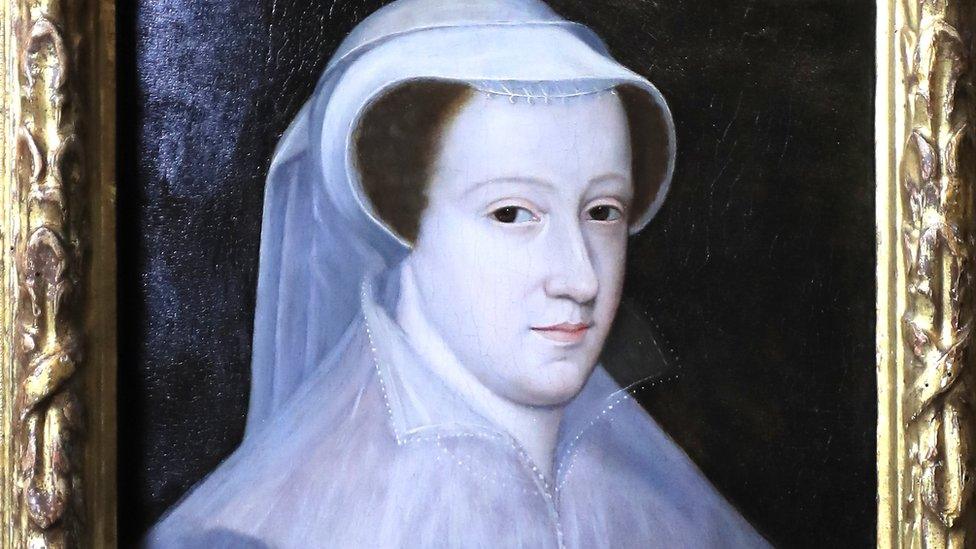
Rare public display for Mary Queen of Scots' final letter

The letter will go on display at Perth Museum for three months
- Published
The public are to be given a rare chance to see the last letter by Mary Queen of Scots, which was written just hours before she was beheaded.
Mary penned the letter in the cell where she had been imprisoned for 19 years by her cousin, Queen Elizabeth I.
Mary tells her brother-in-law, King Henry III of France, that she is "to be executed like a criminal at eight in the morning".
The manuscript will be on show at Perth Museum for three months.
It will be the first time in a generation that the letter will be on prolonged public display.
There were long queues outside the National Library of Scotland's George IV Bridge building in Edinburgh the last time it went on show in 2017.
Mary Queen of Scots was executed on 8 February 1587 for plotting against Elizabeth.
The four-page letter was written in her native French from her prison cell at Fotheringhay Castle, Northamptonshire.
Mary asserts her right to the English crown and her belief that she was being persecuted for her Catholic faith.
She says: "I scorn death and vow that I meet it innocent of any crime."
Mary also asks for her servants' wages to be paid after her death, and signs off: "Your very loving and most true sister, Mary R."

Chris Cassells says the letter has a "relic-like quality"
The manuscript is usually kept in secure storage at the National Library of Scotland (NLS).
Chris Cassells, head of archives and manuscript collections, said it was incredibly special to see it "in the flesh".
"It is really important in that it gives us an insight into Mary's final hours on earth. It is obviously testimony to how she views herself in those final moments," he said.
Mary Stuart was nine months old when she was crowned Queen of Scots following the death of her father, James V, in 1542.
She was raised in France, where she married the heir to the throne, the Dauphin Francis.
Mary was widowed by the age of 18 and returned to Scotland to rule as queen at a time when her Catholicism was viewed with suspicion.

Shona Hunter says they want to reduce the amount of light on the letter
Mr Cassells said Mary's "sincerity of religious conviction" stood out in the letter which had a "relic-like quality".
"It's in her own hand. It has her signature. She touched it. She folded it up to be sent off to France in the hours right before her death.
"So it's undeniably a really special document."
The manuscript is kept in a specially-designed mount to protect it from damage.
Shona Hunter, who works conserving documents at the NLS, said they had to strike a balance between giving people access now while also making sure others will be able to see it in the future.
"It's such an important and precious document that we're really careful about who will see it because we want to reduce the amount of light that will fall onto the object," she said.

Mary Queen of Scots was executed in 1587
Bright or ultraviolet light, in particular, could cause irreversible damage to the letter.
"What we need to do is monitor, control and, where possible, just reduce the amount of light exposure and that way we protect it for generations to come."
The letter will be on display for three months as part of an exhibition at Perth Museum which is due to open on 23 January.
Ashleigh Hibbins, head of audiences at the museum, said it was a "huge coup".
She said Mary had many links to the area and spent a lot of time in Perthshire.
"Most famously, she was actually imprisoned for 11 months in Loch Leven Castle, " she said.
This was where she abdicated the throne in favour of her baby son, James VI.

Ashleigh Hibbins, head of audiences at the museum, said it was a "huge coup"
James was estranged from his mother from infancy and raised a Protestant.
In 1603, following the death of Queen Elizabeth I without a direct heir, he became James I of England, uniting the crowns of the two old enemies.
The fractured relationship with his mother Mary was evident in the hours before her death.
She wrote: "As for my son, I commend him to you in so far as he deserves, for I cannot answer for him."
Ms Hibbins said she believed the intrigue around the life and death of the "doomed queen" would attract visitors.
"To have her last words on display for the first time in a generation, and we believe the first time it's been seen north of Edinburgh, is just fantastic for us," she added.
"It feels like a bit of a homecoming."
- Published18 June
- Published19 April 2024
- Published8 February 2023