🌐 AI搜索 & 代理 主页

Summary

Media caption,

Watch: Jerome Powell announces interest rate cut

  1. Thanks for joining uspublished at 20:30 GMT 10 December

    Powell has wrapped up his remarks. Here's what we've learned today:

    • The US central bank cut interest rates by a quarter percentage point, as expected. That lowered the target for its key lending rate to a range of 3.5% to 3.75%, the lowest since 2022.
    • Fed members remain very divided about what to do next and even about today's move, with three formal dissents and several others signalling reservations on the decision to cut in their projections of appropriate policy.
    • The next move is unlikely to be immediate. Powell said repeatedly he thought the bank was now "well positioned to wait" to see what happens to jobs and inflation.
    • While official forecasts for growth and inflation have improved, Powell said both areas face risks, warning in particular that jobs data could be overestimating hiring. Conversely, he said he was optimistic that tariff-related inflation would not spread to the wider economy.
    • On the ground, today's cut should bring some relief to borrowers. But Powell conceded that the impact may not be large - especially in the housing market, where tight supply remains a significant issue.

    That's all for now. Thanks for joining us.
  2. Powell concludes remarkspublished at 20:24 GMT 10 December

    Jerome Powell has concluded his news conference following the announcement that the Federal Reserve will cut the country's key lending rate by a quarter point.

    This is the third reduction this year brings the key interest rate to 3.50% to 3.75%.

  3. 'We're committed to 2% inflation', Powell sayspublished at 20:15 GMT 10 December

    Powell affirms the Fed's commitment to keeping inflation low and near the Fed's target.

    "We're committed to 2% inflation and we will deliver 2% inflation," Powell says.

    He adds that current inflation is mostly being driven by Trump's aggressive tariffs on countries worldwide. Without those levies, inflation would be "in the low twos".

    "It's really tariffs that's causing most of the inflation overshoot," he said, saying he intends to make sure it's a one-time price increase. "Right now, you've got this difficult balance. There's no risk-free path."

  4. New Fed chair search not affecting Powellpublished at 20:13 GMT 10 December

    Powell is asked to address "elephant in the room": His tenuous relationship with President Trump.

    A reporter asked: "The president has been talking openly about a new Fed chairman, does that hinder your current job right now or change your thinking at all?"

    Powell said simply: "No."

    As a reminder, Powell's term as Fed chair is set to expire in May and Trump is looking to nominate someone else for the position, signalling his preference for someone who will continue to cut rates. We mentioned earlier that a White House adviser, Kevin Hassett, is the current front-runner.

  5. Asked about divided Fed, Powell points to 'persistent tension' in inflation and employmentpublished at 20:11 GMT 10 December

    Asked about disagreement among policymakers about today's cut and the path forward, Powell acknowledged that it's "unusual" to have "persistent tension" between the Fed's two mandates to keep prices stable and unemployment low.

    "And when you do, this is what you see," he said, referring to growing divisions.

    Currently, the central bank is trying to address both inflation and a slow labour market at the same time.

    Still, Powell characterised internal discussions among Fed officials as thoughtful and respectful. He emphasised that nine out of 12 voting members on the Fed's committee supported today's quarter-percentage point cut.

    "We come together and we reach a place where we can make a decision," he said.

  6. AI partly to credit for predicted 'solid growth' next year, Powell sayspublished at 20:02 GMT 10 December

    Asked what's driving the optimistic outlook for next year, Powell says AI can be partly to credit.

    The pickup in growth in the forecasts is due to a number of factors, he says, including "resilient" consumer spending and AI data centres that have been "holding up business investment".

    "It looks like the baseline will be solid growth next year," he says.

  7. 'We're well positioned to wait' - Powellpublished at 20:00 GMT 10 December

    Those, like the president, hoping for additional interest rates cuts, may have to wait.

    Powell has now said, in a few different ways, that he believes that with the cut today, the bank is now "well positioned to wait to see how the economy evolves" before deciding on further action.

    He said officials are facing a "very challenging situation" since there are risks that both unemployment and inflation rise - which would call for opposite responses. "So what do you do? You can't do two things at once," he said. "It's a very challenging situation," he said, adding: "I think we're in a good place to, as I mentioned, wait and see how the economy evolves."

  8. No risk-free path for Fed as it navigates between inflation and unemployment, Powell sayspublished at 19:50 GMT 10 December

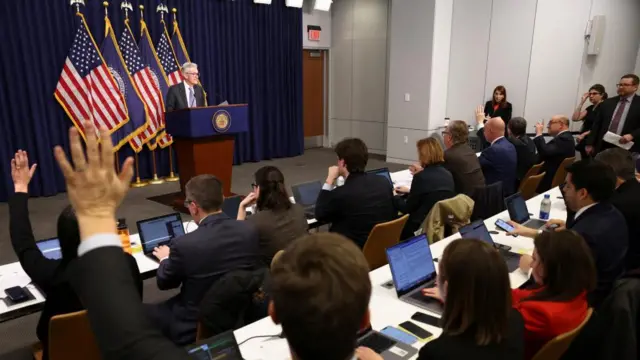
    Jerome Powell addresses reporters at the Federal ReserveImage source, Reuter

    Fed Chair Jerome Powell is speaking now and answering questions. In opening remarks, he says "conditions in the labour market appear to be gradually cooling, and inflation remains somewhat elevated."

    He says the projected unemployment rate is 4.5% through the end of the year but inflation is also rising, which he says could be attributed to tariffs.

    "In the near term, risks to inflation are tilted to the upside, and risks to unemployment to the downside -- a challenging situation," Powell says. "There is no risk-free path for policy as we navigate this tension between our employment and inflation goals."

  9. The outlook for 2026 is still hazypublished at 19:45 GMT 10 December

    Natalie Sherman
    New York business reporter

    This rate cut was widely expected, despite the well-telegraphed divisions among the bank's members, and markets were largely unmoved in the immediate aftermath of the Fed's announcement.

    But what happens next is the big question. Usually, analysts tend to agree on the takeaways from a Fed decision but this time there's little consensus.

    To take just a few examples:

    Ryan Sweet, chief global economist at Oxford Economics, wrote in a note that he thought the Fed was preparing for an "extended pause".

    But Brian Fitch, chief economist at Fitch Ratings, is calling for two cuts by June 2026, while Samuel Tombs, chief US economist at Pantheon Macroeconomics, is calling for three additional cuts next year.

  10. Economic stalling was Biden's fault, says front-runner for succeeding Powellpublished at 19:41 GMT 10 December

    Kevin Hassett, the Trump economic adviser seen as the front-runner to take over the Fed, says the president is trying to fix "Biden's inflation", which he blames for driving up costs for American families.

    "We're making great progress," he says. "The economy is booming, jobs are growing — but people were absolutely harmed."

    Everyday expenses like mortgages and groceries were more expensive after Biden left office, he said. Now, he credits things like "the AI boom" and the building of new factories for the economic growth that is to come.

  11. A Trump loyalist is the front-runner to replace Powell next yearpublished at 19:28 GMT 10 December

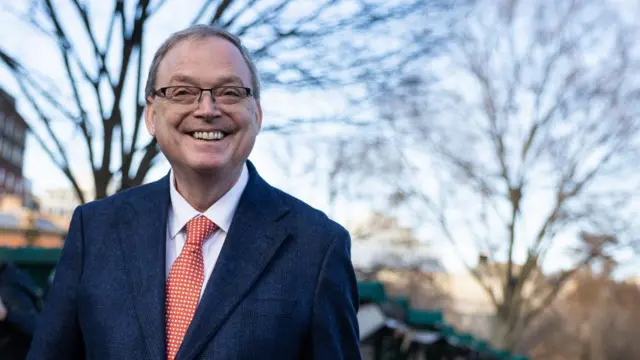
    A smiling man in glasses and a blue suit and red tie with white spots smilesImage source, EPA
    Image caption,

    National Economic Council Director Kevin Hassett

    Soon, we'll hear from outgoing Federal Reserve Chairman Jerome Powell (his term ends in May) about today's decision, but for weeks we've been hearing about President Donald Trump's plans for the central bank after Powell leaves.

    Kevin Hassett, a long-time conservative economist and key Trump economic adviser, is seen as the front-runner to succeed Powell.

    A Trump loyalist, Hassett served as chair of the White House Council of Economic Advisers during Trump's first term and now leads the National Economic Council.

    He has been a stalwart defender of Trump's economic policies, downplaying data showing signs of weakness in the US economy, repeating allegations of bias at the Bureau of Labor Statistics and backing Trump's handling of the Fed.

    "I think that the American people could expect President Trump to pick somebody who's going to help them have cheaper car loans and easier access to mortgages at lower rates," Hassett told CBS, the BBC's US partner, in late November

    Hassett's allegiance to the president has drawn questions from analysts about whether he would act independently at the Fed and how much sway he would have with other members of the board.

    Other names that have been floated for the Fed include economist Kevin Warsh, current Fed Governor Christopher Waller and even Treasury Secretary Scott Bessent.

  12. Powell to speak next after Fed makes rate cutpublished at 19:24 GMT 10 December

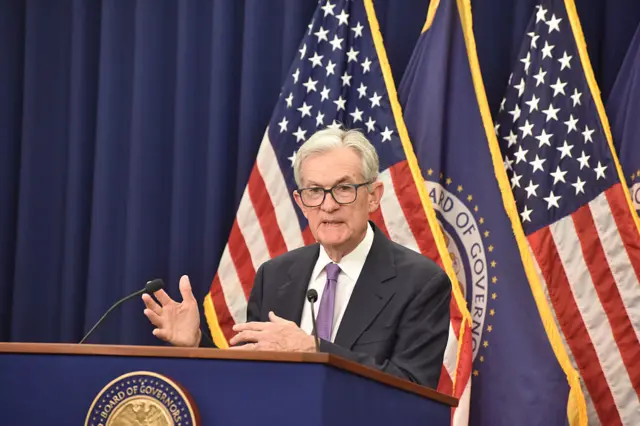
    US Federal Reserve Chairman Jerome Powell delivers remarks at a news conference. He is standing behind a podium and in front id US flagsImage source, VCG via Getty Images

    With the US central bank's new interest rate announced, Fed chair Jerome Powell is set to deliver remarks and answer questions from reporters next. We are also monitoring for comments from Trump or the White House following this afternoon's announcement.

    You can watch the news conference which is scheduled to begin at 14:30 ET (19:30 GMT) at the top of this page.

  13. What's in the future for the economy, according to the Fed?published at 19:22 GMT 10 December

    Natalie Sherman
    New York business reporter

    The Fed's release of its summary of economic projections means we’ve just gotten a glimpse into how board members see the direction for the US economy and interest rates in coming months.

    They are expecting stronger growth and cooler inflation than they were in September. Still, forecasts for interest rate cuts were largely unchanged, with the median projection suggesting just one further cut in 2026.

    But with eight members saying they saw no need for any more cuts, the projections also underscored that they remain divided. That raises uncertainty about the path ahead.

    When it comes to the economy, the forecasts suggested the US economy would expand by 1.7% in 2025, a bit higher than the 1.6% expected in September and by 2.3% in 2026, much stronger than the 1.8% previously anticipated.

    Inflation is expected to cool to 2.4% next year, a slower rate than the 2.6% that had been expected in September. Members expect the unemployment rate to sit at 4.4%, the same as they forecast in September.

  14. What does a lower interest rate mean for Americans?published at 19:16 GMT 10 December

    The Fed's interest rate influences what companies charge people in the US for loans, including mortgages, or other debt, like credit card balances or car loans.

    But a cut doesn't mean all debt gets cheaper. Fixed-rate loans won't change, for example. Also, loans with interest rates tied to other benchmarks, like US Treasuries, may take longer to drop as the Fed's cut works its way into the economy.

    People on adjustable mortgage rates could start paying less. Likewise, people looking for new loans could now find cheaper deals. However, it may take a larger-than-expected cut for those changes to really kick in.

    And don't forget - not everyone is a borrower. If you have savings that earn interest, you could earn less when interest rates dip.

  15. Three Fed policymakers oppose the decisionpublished at 19:10 GMT 10 December

    Danielle Kaye
    New York business reporter

    The decision to cut by a quarter percentage point was not unanimous. Three voting members on the Fed's committee dissented.

    Stephen Miran, who is on leave from his post leading Trump's Council of Economic Advisers, voted for a larger 0.5 percentage point cut. Policymakers Austan Goolsbee and Jeffrey Schmid voted to hold rates steady.

    It's a reflection of widening divisions among policymakers at the Fed as they assess the path forward for interest rates. Prices are rising at the same time that the labour market is showing signs of weakness, putting the central bank's two key mandates in tension with one another.

    Miran and Schmid also dissented at the Fed's last meeting in October - the former in favour of a larger cut, and the latter voting against a cut.

  16. Fed cuts interest rates by quarter of a percentage pointpublished at 19:02 GMT 10 December
    Breaking

    The interest rate has been cut by .25 points, the Federal Reserve has announced.

    This decision brings the new rate to 3.50-3.75%.

  17. What has happened with interest rates already?published at 18:55 GMT 10 December

    Natalie Sherman
    reporting from New York

    The Fed raised interest rates significantly starting in 2022 to get then-soaring prices under control, and pushed them up to more than 5.3% - the highest level in more than 20 years.

    The central bank started to reverse course in 2024 as price inflation subsided, and many borrowers hoped for more relief this year, expecting that the bank would cut rates further.

    A wave of tariffs, however, postponed those plans, renewing fears about a run-up in prices and leading the Fed to hold off, to the immense frustration of President Trump.

    The Fed finally acted in September, as a sharp slowdown in the labour market persuaded policymakers that the economy needed a boost. The cut came even though inflation remains at 3%, the same level as in January and still above the bank’s 2% target.

    The Fed has cut interest rates twice since then, leaving its key interest rate hovering near 3.9%.

  18. The Fed’s economic outlook will also be in focuspublished at 18:50 GMT 10 December

    Danielle Kaye
    New York business reporter

    Investors and economists will be paying close attention to the Fed’s quarterly economic forecast, which is set to be released alongside the interest rate decision.

    The so-called “dot plot” outlines where each Fed policymaker thinks rates will go in the next few years, based on their anonymous forecast, offering some insight into potential future moves and the overall economic outlook for investors.

    The outlook for 2026 remains a big question mark. In September, when the Fed released its last dot plot, policymakers on average predicted one additional 0.25 percentage point cut next year.

    That forecast might hold steady today given the ongoing lack of official economic data, keeping the Fed partially in the dark. Any signs of disagreement among Fed officials about the path forward will be notable and could prompt market reaction.

  19. Analysis

    The Fed was divided going into this meetingpublished at 18:45 GMT 10 December

    Danielle Kaye
    New York business reporter

    The Fed is responsible for helping to keep prices stable and unemployment low. It typically cuts interest rates when it thinks the job market needs a boost and raises them when it thinks prices are rising too quickly.

    Right now, however, both things are happening. Policymakers disagree about the how the Fed should act in the face of these competing priorities.

    The Fed is still operating without official labour market data for October and November, due to the month-long government shutdown. That gives it fewer key economic indicators to rely on while making its decision.

    For now, fears of tariff-driven inflation have taken a backseat to concerns about a weakening labour market, but they have not disappeared.

    This has all been weighing on the bank's open market committee, which decides the direction of its interest rate.

    "It's difficult to recall a time when the Federal Open Market Committee has been so evenly divided about the need for additional rate cuts than the upcoming December meeting," Michael Pearce, chief US economist at Oxford Economics, wrote in a research note.

    Even if the Fed does cut interest rates again today, he said he thought the chance of many additional cuts were low, since he expects the job market to stabilise and inflation to remain above the 2% rate the bank considers healthy.

  20. What are we expecting the Fed to do today?published at 18:39 GMT 10 December

    Natalie Sherman
    New York business reporter

    Wall Street widely expects a quarter-point cut. That would mark the third rate cut since September and lower the target for the bank’s key interest rate to between 3.5% and 3.75% - the lowest since since 2022.

    But going into the meeting, the bank’s policymakers have been unusually divided about whether that’s really the right move.

    It’s their last decision before the end of the year and, complicating matters, they have had less data than usual due to the federal government shutdown in the autumn, which delayed - and in some cases prevented - collecting information on employment and inflation.

    Looming in the background are the tensions between Federal Reserve Chairman Jerome Powell and President Donald Trump. This year, Trump has repeatedly attacked Powell, saying the bank should have cut interest rates earlier and more quickly.

    Stick with us as we bring you the latest from Washington.