🌐 AI搜索 & 代理 主页

Summary

Media caption,

Watch: Nnena Kalu makes history with Turner Prize win

  1. Nnena Kalu makes history with art that showcases 'gorgeous complex forms'published at 21:03 GMT 9 December

    Cachella Smith
    Live reporter

    Nnena Kalu and her art facilitator celebrating her Turner Prize winImage source, PA Media

    This evening, Nnena Kalu has made history - as the first artist with a learning disability to win the Turner Prize.

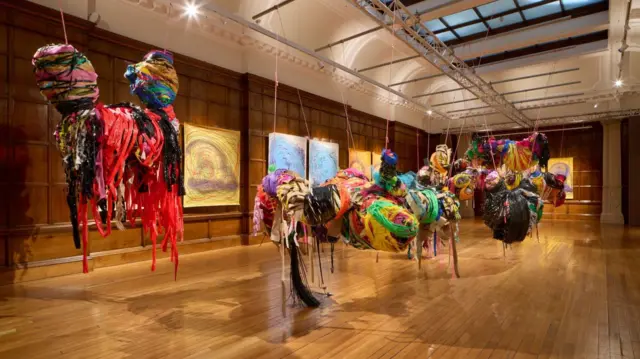
    The judges called her work "bold and captivating" with pieces that feature swirling drawings and hanging sculptures made with materials such as VHS tape and rope.

    Kalu creates "gorgeous complex forms", her artistic director told the audience gathered in Bradford, all the while listening to disco music (apparently very loudly).

    "This amazing lady has worked so hard for such a long time," Charlotte Hollinshead added.

    Our culture editor, Katie Razzall, says this moment could open doors to others, and jury chairman Alex Farquharson agreed it is "historic" as he emphasised the winner was selected on merit.

    We will be ending our live coverage shortly but there's more in our news story.

  2. Imagining how Nnena Kalu produces her artwork is key to understanding itpublished at 20:44 GMT 9 December

    Tinshui Yeung
    Live reporter

    Installation view of Nnena Kalu’s presentation at the Turner Prize 2025Image source, David Levene

    As a viewer, there are plenty of ways to get stuck into a piece of art.

    You can simply look at it, sure - but the real fun comes when you start imagining how the artist actually made it. That, for me, is the best way to experience Nnena Kalu’s winning piece.

    Her enormous sculpture - mostly created by wrapping materials like tape to make “cocoons” - is the product of some seriously physical, repetitive graft.

    It’s all about that repeated movement - up and down, both arms stretching, making circles - as the artist negotiates her relationship with the space around her.

    And the rhythm, which many critics have picked out as a key element, is all about that sound: the roll of tape in your hand, then pull, wrap, pull, wrap.

    It’s almost hypnotic, and that’s what gives the artwork its poetry - it has a knack for capturing the hearts of many.

  3. A short profile of Nnena Kalupublished at 20:37 GMT 9 December

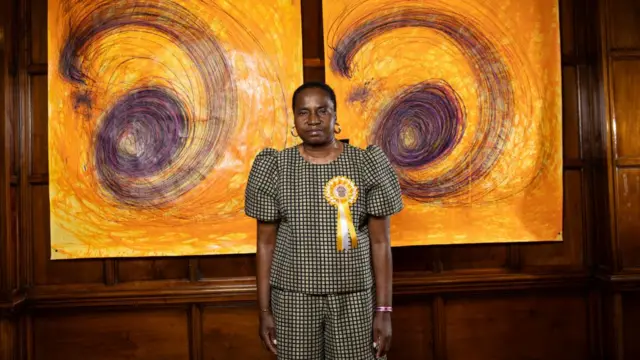
    Nnena Kalu stood in front of some yellow and purple paintingsImage source, PA Media

    Nnena Kalu was born to Nigerian parents in Glasgow in 1966, but the family later moved to Wandsworth in London - where Kalu is still based.

    Kalu is best known for her large sculptural pieces, which create cocoon-like shapes using materials such as fabric, paper and video tape.

    Since 2016, she has shown her work alongside a range of contemporary artists - including Laure Prouvost, who won the Turner Prize in 2013. Kalu also took part in the contemporary art festival Glasgow International in 2018.

    Earlier this year, Kalu held her first solo show outside the UK, at Kunsthall Stavanger in Norway.

    Kalu is a learning-disabled artist with limited verbal communication, and has been a resident artist with ActionSpace, which supports artists with learning disabilities, for more than 25 years.

  4. Kalu's art brings 'a bit of joy'published at 20:29 GMT 9 December

    Ian Youngs
    Culture reporter

    Kalu's work has divided opinion among art critics, but she is "absolutely" a deserving winner, the Yorkshire Post's arts reporter Yvette Huddleston says.

    She tells BBC Radio 4's Front Row: "Going into that [exhibition] room, you have such an interesting emotional response because you have these beautiful, very joyful, colourful hanging sculptures, and then these slightly sinister large-scale drawings, which make you think about possibly being watched."

    The sculptures "feel like friendly creatures", Huddleston says.

    "Especially at the moment, I think we need a bit of joy and a bit of uplift, and I think that's what that work does."

  5. Judges praise ‘beautiful intricacy’ of winner’s artpublished at 20:21 GMT 9 December

    Ian Youngs
    Culture reporter

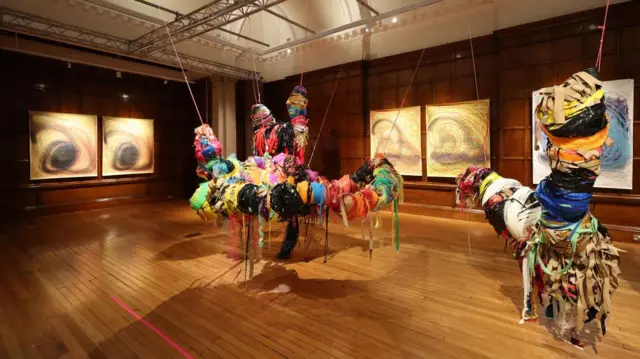
    Nnena Kalu's sculpture in a galleryImage source, EPA

    The Turner Prize judges were impressed by the "really compelling sculptures and drawings that could only be made by Nnena", according to the jury chairman, Tate Britain director Alex Farquharson.

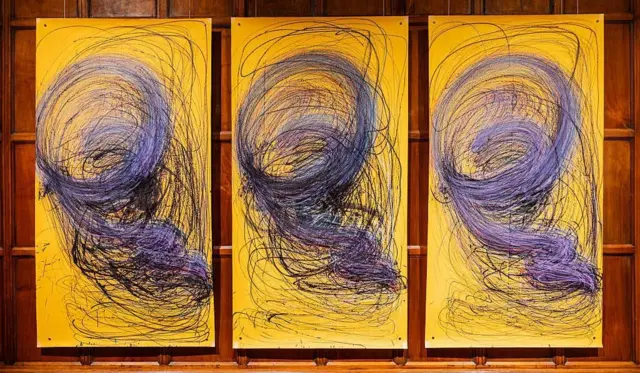
    Her drawings, which come in sets of two or three near-identical shapes, have "a beautiful intricacy to them" and "look like swirling vortexes", he says.

    Her sculptures, meanwhile, are hanging shapes covered in reams of repurposed materials including fabric, rope, parcel tape, cling film and paper.

    They resemble three-dimensional versions of abstract expressionist paintings, Farquharson adds. "But they're not paintings, they're not flat on the wall. They're suspended in the space that you're in, like brightly coloured rocks or creatures.

    "They're at almost your eye level. Although there are no figurative features at all, they appear to be communing among themselves and with you.

    "The use of materials is highly unusual, including video tape that gets wrapped round and round.

    "The colours and the lines the materials make are very like brush marks translated into three dimensions. They're very gestural, they're very expressive, they're very compelling."

  6. ‘Historic’ moment for neurodiverse artistspublished at 20:15 GMT 9 December

    Ian Youngs
    Culture reporter

    The judges deliberated for two or three hours earlier today, according to jury chairman Alex Farquharson, director of Tate Britain, and he stresses that their choice of winner was based purely on merit.

    "The result wasn't about wanting, first and foremost, to give the prize to Nnena as the first neurodiverse artist. That wasn't a driving factor," he says.

    "It was interest in, and a real belief in, the quality and uniqueness of her practice, which is inseparable from who she is."

    It is a historic moment, though, he tells BBC News.

    "It breaks down walls between, if you like, neurotypical and neurodiverse artists. It becomes really about the power and quality of the work itself, whatever the artist's identity is.

    "So maybe what's historic about it is it's one more move to include really great neurodiverse artists in the picture we present of art today."

  7. A landmark moment that potentially opens doors for otherspublished at 20:08 GMT 9 December

    Katie Razzall
    Culture editor

    Nnena Kalu has an innate need to create art.

    She’s compelled to be an artist - and her work is all the more compelling for that. She creates vast swirling drawings and huge hanging sculptures that she makes on a continuous line, wrapping VHS tape, rope and fabric, working to her own rhythm - often, we’re told, dancing to Abba.

    She’s won on merit, say the judges, for work they called “bold and captivating.” But her win is historic. Acknowledging that she is the first artist with a learning disability to triumph at the Turner Prize does not diminish her talents.

    It is seismic.

    As with every Turner year, there will be detractors. That’s what happens. Art appreciation is subjective.

    But this is a landmark moment and potentially opens doors to others who might follow in her footsteps.

  8. She is 'ready to accept her Damehood', Hollinshead sayspublished at 20:07 GMT 9 December

    Charlotte Hollinshead calls this a "major moment" for a lot of people - saying it has broken "a very stubborn glass ceiling".

    "As Nnena is such a superstar, has worked so hard and has made history, she is ready to accept the call from the Palace about her Damehood," Hollinshead finishes to laughter and cheers.

  9. Kalu 'creates gorgeous complex forms all while listening to disco music'published at 20:02 GMT 9 December

    Hollinshead, speaking on Kalu's behalf, continues with some remarks following the artist's win.

    "We are so happy that Nnena's talent and beautiful work is now out in the world for you all to see," she says.

    "This complex artist creates gorgeous complex forms all while listening to disco music - often as loud as possible," she jokes to cheers from the room.

    She adds that Kalu began working with ActionSpace, an organisation which provides access to creative studios and professional guidance for those with learning disabilities across London, in 1999.

    At the time her work "was not respected" and "certainly wasn't regarded as cool".

    Hollinshead adds that Kalu has faced discrimination for her learning disability which continues to this day. "Hopefully this award smashes that prejudice away," she says.

    Kalu is a learning disabled artist with limited verbal communication.

  10. Kalu has worked 'so hard for such a long time' - artistic facilitator sayspublished at 19:54 GMT 9 December

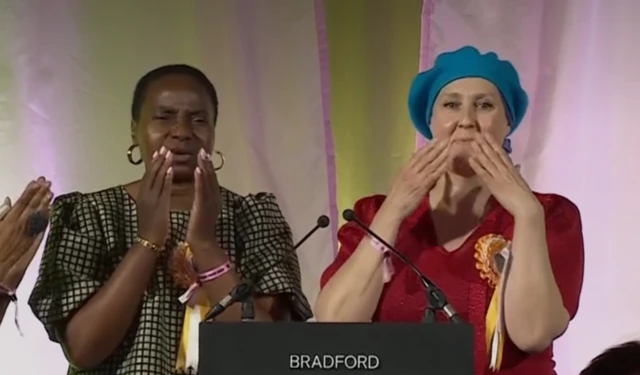
    Nnena Kalu and Charlotte Hollinshead blowing kisses from behind a podium

    Nnena Kalu has been named as the winner of the Turner Prize - an announcement met with applause and cheers in Bradford.

    Charlotte Hollinshead, Kalu's artistic facilitator, speaking on her behalf, says: "Nnena Kalu was a superstar."

    "This amazing lady has worked so hard for such a long time - it's wonderful she's finally getting the recognition she rightly, rightly deserves."

  11. Nnena Kalu wins 2025 Turner Prizepublished at 19:49 GMT 9 December
    Breaking

    It's just been announced that Nnena Kalu has won this year's Turner Prize.

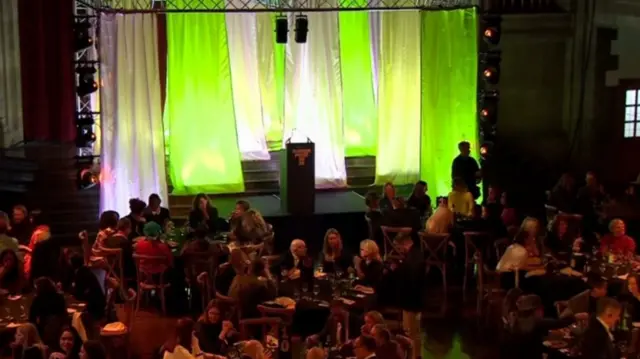
  12. Stage decorated in green and white ahead of announcementpublished at 19:39 GMT 9 December

    The stage is set for the Turner Prize ceremony. Attendees sit at tables

    Let's turn now to Bradford, where people are gathering ahead of the Turner Prize winner's announcement.

    The stage, complete with a podium, has been decorated with a number of sheets - lit up in white and green.

    We can also spot a number of attendees seated at tables as they wait for the big reveal.

    You can watch those scenes yourself by clicking watch live above.

  13. Memorable and controversial moments - in picturespublished at 19:36 GMT 9 December

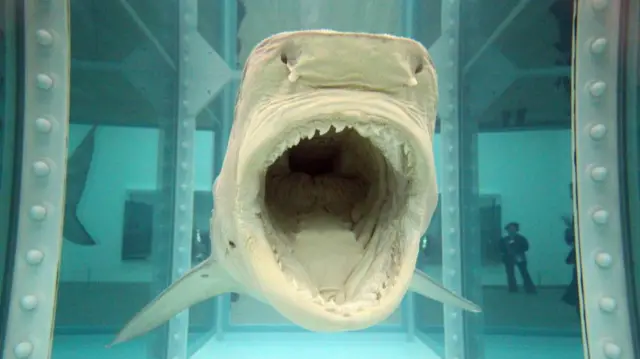
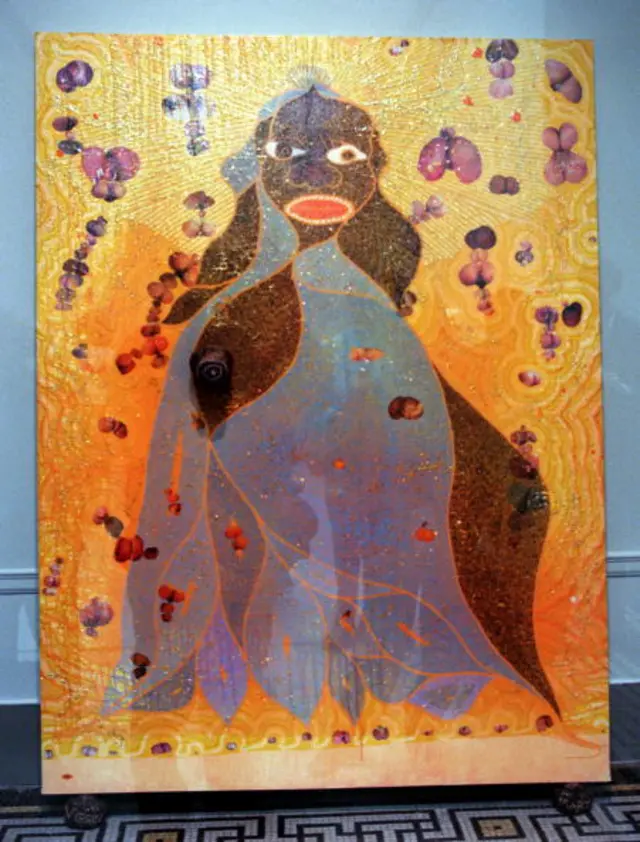
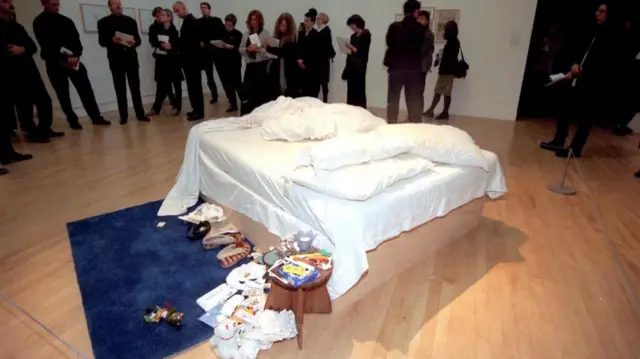
    "Varied" would be a good way to describe the artworks that have competed for the Turner Prize over the years. The juries have seen everything: from a messy bed, to a painting made of elephant dung.

    Some of the prize's most memorable works didn't actually win in their year. But - as with Tracey Emin's My Bed - they attracted intense media attention and launched the artist's career nonetheless.

    We've taken a look back at some of the most memorable winners - or not - of the Turner Prize.

    A shark with its mouth open preserved in blue liquidImage source, Press Association
    Image caption,

    Damien Hirst's formaldehyde shark - titled The Physical Impossibility of Death in the Mind of Someone Living - was nominated in 1992, but didn't win. He went on to win the prize in 1995

    A yellow and blue painting with splotches all over itImage source, AFP via Getty Images
    Image caption,

    The 1998 winner was Chris Ofili for his painting The Holy Virgin Mary - controversial for its use of elephant dung

    Tracy Emin's My Bed is an unmade bed, with a blue rug next to it and litter strewn aroundImage source, Press Association
    Image caption,

    Though it didn't win the 1999 prize, Tracy Emin's provocative sculpture My Bed - which is, well, her own bed - drew significant media attention

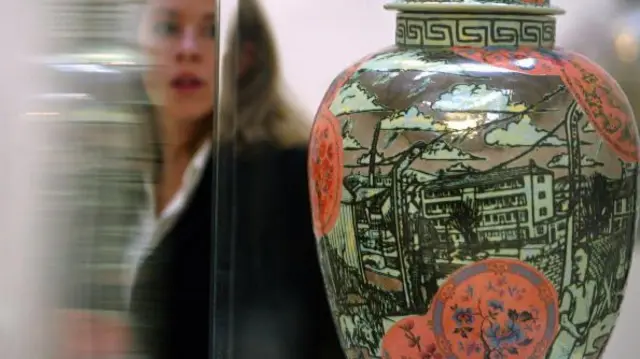
    A green and red pot, with an urban scene depicted on itImage source, Getty Images
    Image caption,

    Grayson Perry won in 2003 for ceramic works which - though brightly coloured and decorative - explore dark themes

  14. Turner Prize winner to be announced in next 30 minutespublished at 19:30 GMT 9 December

    We're expecting the winner of this year's Turner Prize to be announced within the next half an hour.

    Our stream of the event has now started - click watch live to follow along at the top of the page.

    The winner will then be announced at around 20:00 GMT - stick with us.

  15. How is the winner chosen?published at 19:26 GMT 9 December

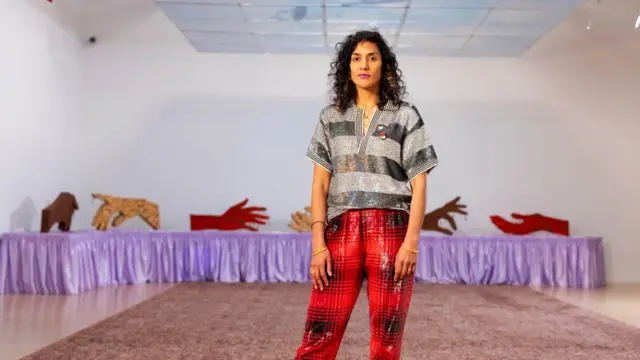
    Jasleen Kaur, in red trousers, stands in front of a table with a purple cloth on it and large sculptures of handsImage source, PA Media
    Image caption,

    Jasleen Kaur won last year's Turner Prize

    The Turner Prize shortlist and winner are chosen by an independent panel of experts.

    The panel includes gallery directors, curators, critics and writers. At least one member is from abroad, to balance British art with a broader context.

    This year, the jury includes representatives from the National Gallery, the Fitzwilliam Museum in Cambridge, the Liverpool Biennial of Contemporary Art, and the Monsoon Art Collection - which features work from Central and South America, Africa and Asia.

    The panel is chaired by Alex Farquharson, director of Tate Britain.

    Jury members will select a winner from the shortlist on the day of the announcement, through discussion and consensus.

  16. Let's take a look at this year's nomineespublished at 19:19 GMT 9 December

    English flags, Korean spirits, reels of VHS tape and apocalyptic war zones all make appearances in the works shortlisted for the 2025 Turner Prize.

    The four shortlisted artists are:

    • Zadie Xa
    • Rene Matić
    • Nnena Kalu
    • Mohammed Sami

    Their installations have been on display at Cartwright Hall Art Gallery in Bradford since September.

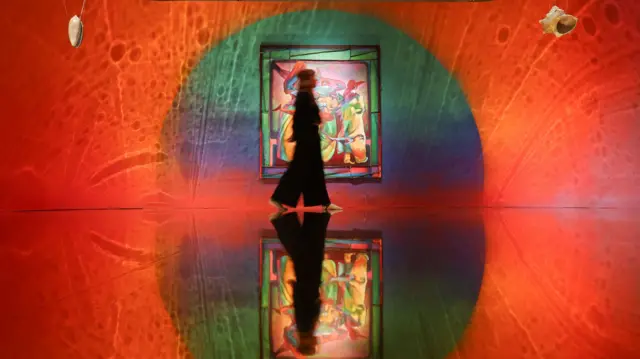
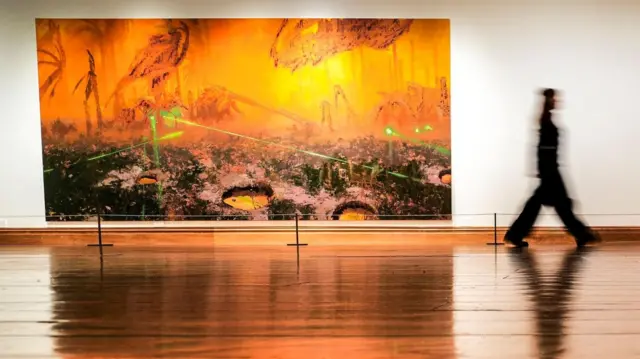
    A woman walking past a large colourful painting in a gallery bathed mostly in red light and swirling shapes in Zadie Xa's installationImage source, EPA
    Image caption,

    Zadie Xa's paintings are surrounded by swirling colour projections on the walls and floor

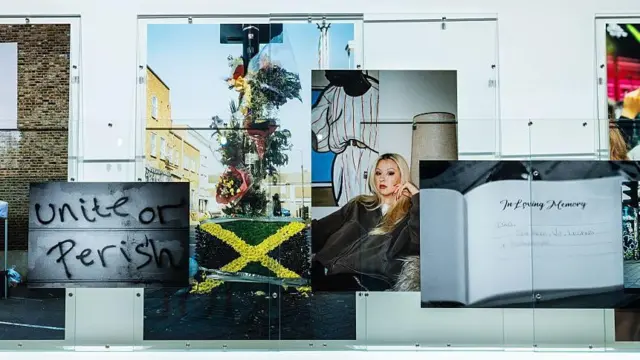
    A series of Rene Matic's photographs on the gallery wall including a young woman, a floral tribute with a Jamaican flag, graffiti reading "unite or perish" and a book of condolenceImage source, Getty Images
    Image caption,

    Rene Matić's photographs show snapshots from the artist's life

    Three large yellow paintings by Nnena Kaluin a row with identical blue swirly patternsImage source, Getty Images
    Image caption,

    Tape, ribbons, string and cardboard are among the materials used to make Nnena Kalu's sculptures

    The Hunter's Return by Mohammed SamiImage source, PA Media
    Image caption,

    Mohammed Sami's paintings are striking and large, giving a visceral sense of the aftermath of a warzone

  17. JMW Turner, the artist on your £20 note, celebrates 250th birthdaypublished at 19:10 GMT 9 December

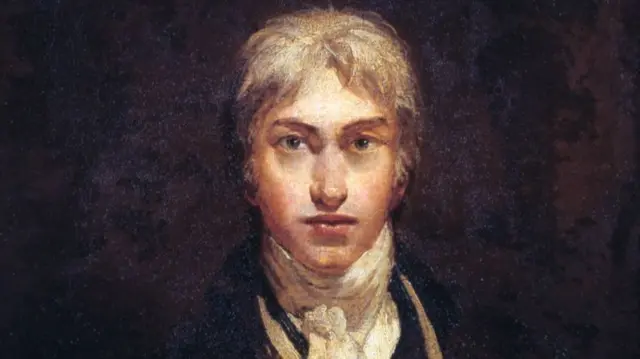
    Artist Joseph Mallord William Turner (1775-1851), "Self portrait, age 24"Image source, Universal History Archive

    Winning this year's Turner Prize may feel especially poignant, as it also marks the 250th birthday of JMW Turner - the artist the prize is named after.

    In fact, the shortlist was revealed on what would have been his birthday, 23 April.

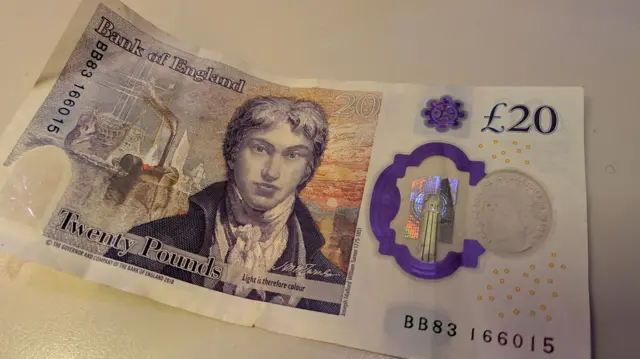
    Turner is one of the most celebrated English artists in history. His Romantic masterpieces include The Fighting Temeraire - and if you haven’t seen it, check your £20 note. It was also once voted Britain’s favourite painting.

    Living in the era of the industrial revolution, Turner believed the artist’s job was to respond to the changing times. He thought that the old skill of painting wooden sailing ships was becoming outdated. Instead, artists should find beauty in the new - iron funnels, valves, and paddle wheels.

    You can see all of this in The Fighting Temeraire, which shows the old HMS Temeraire being towed up the Thames by a steam tug in 1838, before being broken up for scrap.

    A £20 banknote
    Image caption,

    This £20 picture is hot off the news desk

  18. What is the Turner Prize - and how much is the prize money?published at 19:00 GMT 9 December

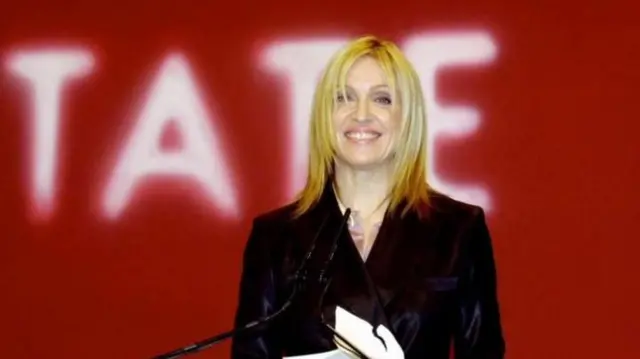
    Madonna in a black jacket with straight blonde hair stands at a podiumImage source, PA Media
    Image caption,

    Madonna presented the Turner Prize in 2001

    It’s arguably the UK’s most famous art prize.

    Since its debut in 1984, the Turner Prize has been handed out each year to a British artist - that could be someone working mainly in the UK, or a British-born artist making waves around the globe.

    Over the years, celebrities including Yoko Ono and Madonna have presented the prize.

    This year’s shortlisted artists each pocket £10,000 ($13,294), with the winner walking away with £25,000 ($33,242).

    Every other year, the prestigious prize decamps from London – this year, it’s Bradford’s turn to play host, although next year it ventures away from the capital again, and will be hosted in Middlesbrough.

    While the contemporary art world sees it as a badge of global recognition, the conceptual flavour of many of the nominated works has split opinion.

    Back in 2002, then-Culture Minister Kim Howells famously said: “If this is the best British artists can produce then British art is lost.”

    He even threw in an expletive for good measure.

  19. The Turner Prize's origins - art's answer to Miss World?published at 18:57 GMT 9 December

    Ian Youngs
    Culture reporter

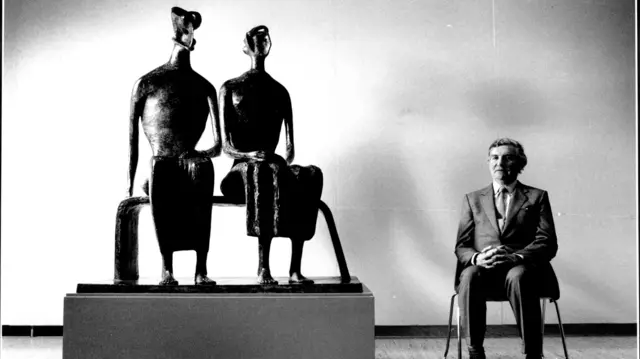
    Black and white photo of Alan Bowness sitting next to a Henry Moore sculpture featuring two seated figures in 1992Image source, Getty Images
    Image caption,

    The prize was set up by the Patrons of New Art, led by Alan Bowness

    The Turner Prize was set up in 1984 to bring extra attention to Britain's contemporary artists, at a time when they didn't get much space in either the Tate gallery or the media.

    It was named after JMW Turner, one of Britain's greatest and most singular painters, who by coincidence was born 250 years ago this year.

    The prize was set up by a group of donors called the Patrons of New Art, led by Alan Bowness, who explained the motivation behind the idea to BBC radio in November 1984.

    Quote Message

    We all know the world thinks highly of our rock musicians but we don’t necessarily know that the world thinks highly of our painters, and this kind of publicity and razzamatazz and bit of Miss World-type show business excitement seems to me to be no bad thing.”

    Alan Bowness

    His reference to Miss World as one of the inspirations - and his assumption that the Turner Prize would mainly be for painters - show how times have changed over the last 41 years.

  20. David Hockney's old school is hosting the ceremonypublished at 18:53 GMT 9 December

    Guy Lambert
    Culture reporter in Bradford

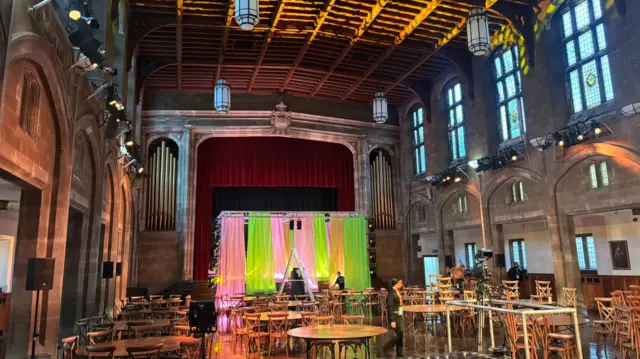
    Interior of Bradford Grammar School hall with tables and a stage set up for the ceremony
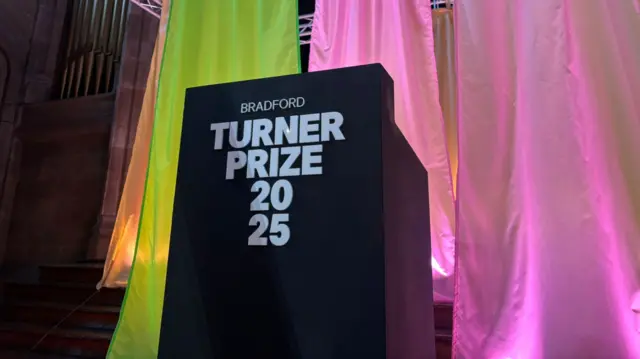
    A podium with the words "Turner Prize 2025" in front of a yellow and pink curtain backdrop

    What better place to host this year's ceremony than the school of one of Bradford's favourite sons, artist David Hockney?

    Hockney attended Bradford Grammar School from 1948 to 53, and it's just across the park from the Cartwright Hall gallery, where work by this year's Turner Prize nominees is currently on show.

    Hockney once turned down the offer of a knighthood saying he "didn’t value prizes".

    But with £25,000 for the winner here tonight, while there's a lot of excitement in the room, for the four nominees I think there may well be a few nerves as well!