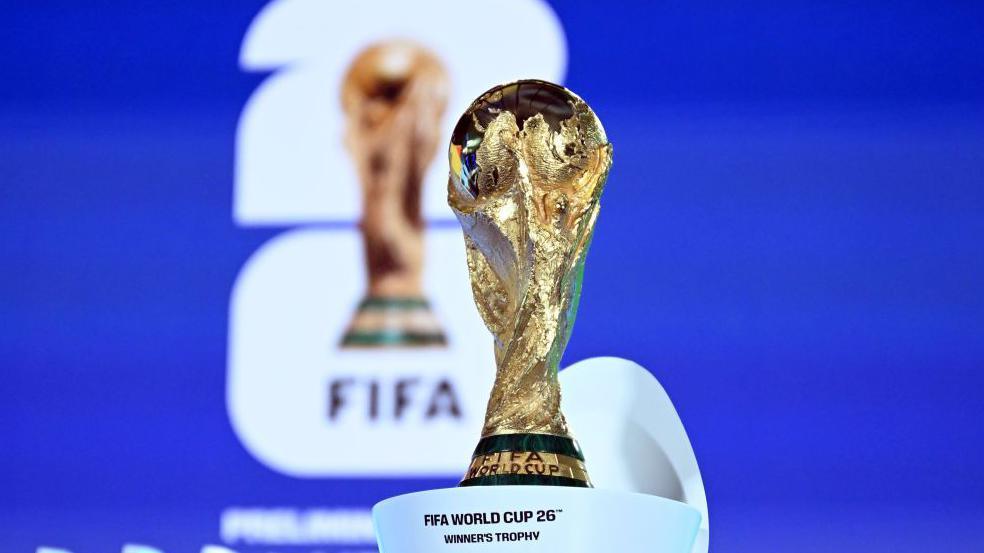
BBC or ITV? Inside how World Cup broadcast picks are made

BBC have the first pick for 2026 World Cup matches
- Published
The countdown to the men's Fifa World Cup is on and we now know the fixture schedule as well as the broadcast picks.
But it is not an easy process for TV executives tasked with the job of working out who televises each game.
In the UK, the BBC and ITV have screened football's global showpiece together since 1966. Last year they agreed a deal to share live coverage again in 2026 and 2030, ensuring the World Cup remained on free-to-air television.
The two broadcasters will share the rights equally for the 2026 tournament, splitting matches between them, including a shared final.
But how is it decided who shows which matches? How does the process work? And what goes on inside the room on the day?
'An even split'
Executive producer Phil Bigwood knows exactly how it all works behind the scenes. He's been part of the BBC's World Cup team for more than 20 years.
The process - or 'split' as Phil calls it is simple: The BBC and ITV take it in turns to have the first pick and rotate it between tournaments - it's the same with the Euros.
This time it's the BBC's turn to pick first. Once they've picked their first match, ITV then choose theirs, and it goes back and forth until all the matches have been allocated. Then both the BBC and ITV broadcast the final.
"We typically end up with an even split with the priority games like England, Scotland and the knockout matches having the highest value," says Bigwood.
"For this World Cup there are 91 picks in total and we get 10 minutes to make each one - although we don't always need that long.
"For the Euros in Berlin last year it took a few hours to get through, but this will take a lot longer. There's normally quite a lot of coffee drunk!"
BBC to show Scotland's first World Cup game since 1998
- Published1 day ago
Coming up with a plan
Before the split takes place though, both sides have to do their homework.
Following the draw - which was made on Friday - broadcasters find out when and where the matches will be. The job then is to come up with a plan for which games take priority.
"We have a couple of days of conversations - at least - around what we would like to do and which way we might want to go," Bigwood adds.
"In the BBC's case we've got other scheduling like Wimbledon to take into account - for ITV they've got their commercial considerations. You need to weigh all this up as part of your strategy.
"You plot through each match and you also have a day by day schedule. No broadcaster wants to end up in a situation where you have four live games on one day."
There's lots to consider - covering matches involving the home nations is paramount and predicting who might face each other in the knockout stages is also key.
Kick-off times need to be taken into account too. The tournament across the USA, Canada and Mexico will have 13 different kick-off times, which adds an extra layer of complication.
None of this is a perfect science.
"You have to weigh up how far you think a team might progress," he adds. "If there's a big team - say in England's group - do you go with that or something else? That's always the big conundrum.
"Once we've all agreed on what pick we want we'll then phone ITV and confirm it, they then have the next pick. We're not in the same room and we never know which way they're going to go."
The plan both sides have in place has to be constantly tweaked - after all ITV might well pick one of the matches the BBC had their eyes on, and vice versa.
Hedging your bets and trusting luck

England manager Roy Hodgson resigned after the humiliating Euro 2016 last-16 defeat by Iceland
Alongside the group games, both sides need to choose which picks they will have from the knockout rounds during the tournament. These will be some of the best games - but no one yet knows what those matches will be.
"This is where a bit of guesswork comes in," explains Bigwood.
"At Euro 2016 we anticipated that England could face France in a blockbuster quarter-final," he said. "But England lost to Iceland in the last-16 so we didn't get the game we wanted."
The broadcasters also have to balance up a time slot with the appeal of a match.
"For example, at the Brazil World Cup there was one early-hours game that was due to be played in Manaus up in the Amazon.
"We joked that it was going to be the last pick because we thought nobody would want that game. But it ended up being England v Italy and was one of the top BBC picks. Afterwards we were laughing – we thought it was the one game we were all trying to avoid!"
With so many variables and unknowns a lot of the TV scheduling comes down to luck.
"If it goes to a penalty shootout then you're in the hands of 22 blokes on a field. You're just hoping your gambles pay off. But there's absolutely nothing you can do to control those knockout games. We'll always have things that don't work in our favour.
"Let's be honest, we could all sit here and do a lottery and predict every result through to the final but nobody's going to be right are they?"
Friends or foes?
Despite the competition and the battle for ratings, do both sides get on? Are there any disagreements or heated exchanges during the split?
"We've known the guys at ITV for many years. Some of them used to work at the BBC and we're friends with a lot of them - it's a partnership.
"Both sides know what their priority games will be. We'll sometimes throw each other a curveball with a pick choice but it never gets heated or anything like that.
"Obviously it's for the benefit of everyone that both parties come away and are happy with what they've got."
The work has only just begun
The split always takes place as close as possible to the draw - this is really important so that broadcasters can then start on the complicated logistics of covering so many games.
"After the split has been agreed and ratified we attend a world broadcaster meeting - that's when Fifa update everybody on the production plans.
"We get told everything from how visas and customs will work to where camera positions will be.
"Our BBC team then has to submit every booking that is required for all the games. That includes every car park pass we'll need, every camera position, every lines feed - literally everything - it's quite a lively time!
"Then there are hotel bookings, flights and so on. This is undoubtedly the most difficult bit of the process."
The BBC approached ITV for comment but they chose not to contribute.
Related topics
- Published5 days ago
- Published2 days ago
- Published3 days ago