Israel reopens Gaza's key Rafah border crossing with Egypt

 AFP
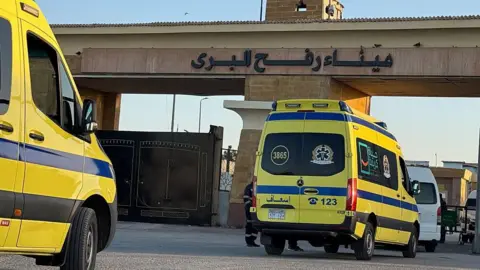
AFPSick and wounded Palestinians from Gaza have arrived in Egypt after the key Rafah border crossing reopened for the movement of people.
The crossing has largely been closed since May 2024, when the Gazan side was captured by Israeli forces.
The reopening was supposed to happen during the first phase of US President Donald Trump's ceasefire plan between Israel and Hamas, which began in October. But Israel blocked it until the return of the body of the last Israeli hostage in Gaza, which happened last week.
It will come as a relief to many Palestinians who see it as a lifeline to the world, although there is frustration that only small numbers of people and no goods will be allowed through.
Around 20,000 sick and wounded Palestinians are waiting to leave Gaza for treatment, according to local hospitals and the World Health Organization (WHO).
Israeli reports say only 50 patients - accompanied by one or two relatives - will be allowed to exit each day, and that 50 people who left Gaza during the war will be allowed to return.
It is understood that there was disagreement over whether carers should be allowed to return from Egypt with former patients as part of that quota, which caused some delays.
The crossing will be run by supervisors from the European Union and local Palestinian staff, while Israel will carry out stringent security checks remotely.
On Monday morning, an Israeli security official said the Rafah crossing had "now opened to the movement of residents, for both entry and exit" following the arrival of teams from the European Union Border Assistance Mission (EUBAM).
Al Qahera News TV, which is close to Egyptian intelligence, meanwhile said the crossing had "received the first batch of Palestinians returning from Egypt to the Gaza Strip".
After sunset, Al Qahera broadcast footage appearing to show ambulances transferring patients across the border into Egypt.
"Three ambulances have arrived so far carrying a number of the sick and injured, who were immediately screened upon arrival to determine to which hospital they will be transferred," an Egyptian health official at the border told AFP news agency.

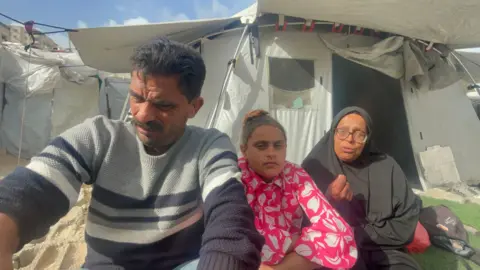
A Palestinian mother, Sabrine al-Da'ma, told the BBC she was hoping to travel abroad with her 16-year-old daughter, Rawa, who suffers from kidney disease. She plans to donate Rawa one of her kidneys.
"She used to be treated through monitoring, ultrasound imaging and tests to check the condition of her kidneys. Since the war started, because of food shortages, hunger, and the food she was forced to eat, she began dialysis," Da'ma said.
"We hope they will speed up our referral so that we can travel quickly, because she is getting exhausted. I am also 45 years old, and they may tell me that as I get older, I won't be able to donate anymore. That's why we're rushing."
Maha Ali, 26, told the BBC that she was hoping to leave Gaza to study a master's degree in Algeria, but that she had previously been told by Israeli authorities that they did not consider students to be "humanitarian cases".
"By now, I was supposed to have defended my master's thesis and started my PhD, but two years of my life have been lost. I am now in Gaza and I have not been able to do anything I had planned," she said.
The head of the Palestinian technocratic committee due to take over day-to-day running of Gaza, Ali Shaath, said the reopening of the crossing marked "the beginning of a long process that will reconnect what has been severed and open a genuine window of hope for our people in the Gaza Strip".
The EU's foreign policy chief, Kaja Kallas, said: "The opening of the Rafah crossing marks a concrete and positive step in the peace plan."
UK Foreign Secretary Yvette Cooper also welcomed the move, but stressed that "much more still needs to be done". "Aid must flow in, restrictions on essential supplies must ease, and aid workers must be allowed to operate," she added.
On Sunday, Israeli authorities said a trial opening of the crossing was carried out and completed.
One Palestinian official familiar with the arrangements for the trial told the BBC that around 30 Palestinian staff members had arrived at the Egyptian side of the crossing, ahead of the initial operational phase.
The WHO will oversee the transfer of patients from territory under Hamas control, transporting them by bus to the crossing over the "Yellow Line" and into territory controlled by the Israeli military.
About 150 hospitals and 300 ambulances in Egypt are ready to receive the evacuated patients, according to Al Qahera News.
Trump's 20-point Gaza peace plan says the reopening of the Rafah crossing in both directions will be subject to the same mechanism implemented under a previous ceasefire deal in January last year.
Before being seized by Israel in 2024, the crossing was the main exit point for Palestinians allowed to leave during the war and a key entry point for humanitarian aid. Now, aid that enters from Egypt is routed via Israel's Kerem Shalom crossing point.
In December, the Israeli government said the Rafah crossing would open to allow Palestinians to leave Gaza. But Egypt said the crossing would only be opened if movement was allowed in both directions.
More than 30,000 Gazans have registered with the Palestinian embassy in Cairo to be allowed to return to Gaza.
The crossing's opening was delayed due to the Israeli government making it conditional on Hamas handing over the body of the last dead Israeli hostage in Gaza.
Last week, the Israeli military said its troops had retrieved the remains of police officer Master Sgt Ran Gvili at a cemetery in northern Gaza.
He was one of the 251 people abducted by Hamas and its allies during their attack on Israel on 7 October 2023, which killed around 1,200 people.
Israel's military campaign in Gaza, launched in response to the attack, has killed more than 71,800 Palestinians, according to the territory's Hamas-run health ministry.
Both sides have accused each other of repeated violations since the ceasefire began 16 weeks ago. The health ministry has said 526 people have been killed by Israeli fire, while the Israeli military has said four of its soldiers have been killed in Palestinian attacks.