AI 'slop' is transforming social media - and a backlash is brewing

 BBC
BBCThéodore remembers the AI slop that tipped him over the edge.
The image was of two emaciated, impoverished South Asian children. For some reason, despite their boyish features they have thick beards. One of them had no hands and only one foot. The other was holding a sign saying it's his birthday and asking for likes.
Inexplicably they are sitting in the middle of a busy road in the pouring rain with a birthday cake. The image is full of tell-tale signs that it was made with AI. But on Facebook it went viral with nearly one million likes and heart emojis.
Something snapped in Théodore.
"It boggled my mind. The absurd AI made images were all over Facebook and getting [a] huge amount of traction without any scrutiny at all - it was insane to me," says the 20-year-old student from Paris.
So Théodore started an account on X, formerly known as Twitter, called "Insane AI Slop" and started calling out and poking fun at the content he came across that was fooling people. Others took notice and his inbox soon became flooded with people sending submissions for popular so-called AI slop.
 Left: Théodore. Right: “Baby Bubbles and Babbles” Facebook page.
Common themes started becoming apparent - religion, military or poor children doing heartwarming things.
"Kids in the third world doing impressive stuff is always popular - like a poor kid in Africa making an insane statue out of trash. I think people find it wholesome so the creators think, 'Great, let's make more of this stuff up,'" Théodore says.
Théodore's account soon swelled to over 133,000 followers.
The onslaught of AI slop - which he defines as fake, unconvincing videos and pictures, made quickly - is now unstoppable. Tech companies have embraced AI. Some of the firms say they are starting to crack down on some forms of AI 'slop' - though many social media feeds still appear to be full of the content.
Over just a couple of years, the experience of using social media has changed profoundly. How did it happen, and what effect will it have on society?
And, perhaps most pressingly of all, how much do the billions of social media users actually care?
Social media's 'third phase'
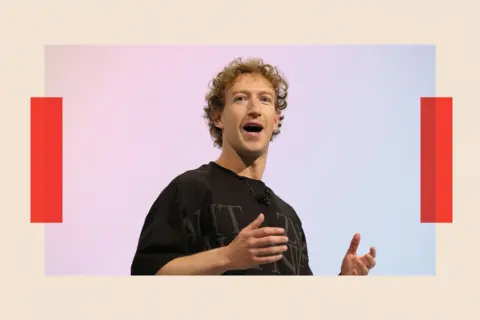
In October, during another jubilant earnings call, Meta CEO Mark Zuckerberg happily declared that social media had entered a third phase, which is now centred around AI.
"First was when all content was from friends, family, and accounts that you followed directly.
"The second was when we added all of the creator content. Now as AI makes it easier to create and remix content, we're going to add yet another huge corpus of content," he told shareholders.
Meta, which runs social media sites Facebook, Instagram and Threads, is not only allowing people to post AI generated content - it's launched products to enable more of it to be made. Image and video generators and increasingly powerful filters are now being offered across the board.
When approached for comment, Meta pointed the BBC to January's earnings call. In that call, the billionaire said the firm was leaning even more into AI, and made no mention of any clampdown on slop.
"Soon we'll see an explosion of new media formats that are more immersive and interactive, and only possible because of advances in AI," Zuckerberg said.
YouTube's CEO, Neal Mohan, wrote in his 2026 look-ahead blog that in December alone more than one million YouTube channels used the platform's AI tools to make content.
"Just as the synthesizer, Photoshop and CGI revolutionized sound and visuals, AI will be a boon to the creatives who are ready to lean in," he wrote.
The CEO also acknowledged that there are growing concerns about "low-quality content, aka AI slop". He said his team is working on ways to improve systems to find and remove "low quality, repetitive content".
 Reuters
But he also ruled out making any judgements on what should and shouldn't be allowed to flourish. He pointed out that once-niche content like ASMR (soothing sounds designed to make your scalp tingle) and live video game-playing is now mainstream.
According to research from AI company Kapwing, 20% of content shown to a freshly opened YouTube account is now "low-quality AI video".
Short-form video in particular was a hotspot, with Kapwing finding it featured in 104 of the first 500 YouTube Shorts clips shown to a new account created by the researchers.
The creator economy seems to be a big driver as people and channels can earn money from engagement and views. Judging by the views on some AI channels and videos, people are indeed drawn to the content - or the algorithms that dictate what we see are, anyway.
According to Kapwing, the AI slop channel with the most views is India's Bandar Apna Dost, which has 2.07 billion views, netting the creators an estimated annual earnings of $4m (£2.9 million).
But there is something of a backlash taking place too.
Under many viral AI videos, it's now common to see a furious flurry of comments decrying the content.
Giant monsters and deadly belly parasites
Théodore, the student from Paris, helped to drive this backlash.
Using his newfound influence on X he complained to YouTube moderators about the flood of weird AI cartoons that got huge numbers of views. In his view they were disturbing and harmful, and in some cases appeared to him to be aimed at children.
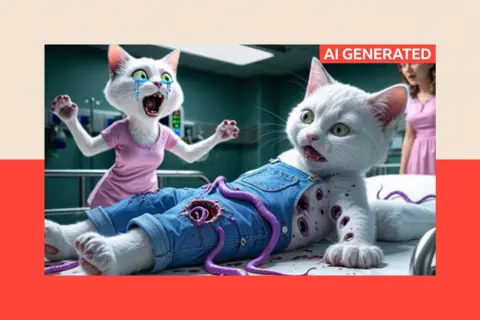
The videos were called things like "Mum cat saves kitten from deadly belly parasites", and showed gory scenes.
Another short clip showed a woman in a night dress who eats a parasite and then turns into a giant angry monster that is eventually healed by Jesus.
 'Sprung Nexus' YouTube account
YouTube removed the channels, telling us they did so because they violated their community guidelines. They said they are "focused on connecting our users with high-quality content, regardless of how it was made", and said they are working to "reduce the spread of low quality AI content".
But that experience, plus many others like it, have ground Théodore down.
 Unknown
Even seemingly cosy lifestyle sites like Pinterest - the forum for recipes and interior design ideas - have been affected.
Users have become so frustrated by the deluge of AI slop that the company introduced a new opt-out system for AI-generated content - but this relies on users admitting that their perfect-house imagery is AI made.
Fury in the comments section
On my feed (and I'm aware that everyone's feed is different - including the comments) - the backlash to AI slop has become incessant.
Whether it's TikTok, Threads, Instagram or X - there seems to be a people-power movement against this content.
Sometimes the number of likes for the AI backlash comments far exceed the original post. Such is the case with a recent video showing a snowboarder rescuing a wolf from a bear. The video itself had 932 likes - versus 2,400 likes for a commenter who wrote, "Raise your hand if you're tired of this AI s**t".
But of course it all feeds the beast.
All engagement is good engagement for social media platforms where keeping us scrolling is key.
So does it actually matter if the amazing, heartwarming or shocking video on your social feed is real or not?
The 'brain rot' effect
Emily Thorson, associate professor at Syracuse University in the US, who specialises in politics, misinformation and misperceptions, says it depends on what people are doing on the social media platform.
"If a person is on a short-video platform solely for entertainment, then their standard for whether something is worthwhile is simply 'is it entertaining?'," she says. "But if someone is on the platform to learn about a topic or to connect with community members, then they might perceive AI-generated content as more problematic."
How people feel about AI slop also depends on how it is communicated.
If something is made clearly as a joke, it seems to be taken as such. But when AI slop has been created specifically to deceive, it can anger people.
One AI-generated video I saw recently is emblematic: an incredibly realistic, natural-history-style video of an astonishing leopard hunt. In the comments, some viewers were fooled; others were unsure.
"What documentary is it from?," one commenter asked. "Please - it is the only way to [prove] no AI."
 Unknown
Alessandro Galeazzi, from the University of Padova in Italy, researches social media behaviour and echo chambers.
He says that verifying whether or not a video is AI takes mental effort, and over the long run, he fears people will simply stop checking.
"My feeling is that the flood of nonsense, low-quality content generated using AI might further reduce people's attention span," he says.
He distinguishes content that is intended to deceive with the more comical and obviously-fake AI slop, like fish with shoes, or gorillas lifting weights at the gym.
But even that more whimsical content might also have a damaging impact. He talks of the risk of "brain rot" - the idea that our constant exposure to social media is harming our intellectual abilities.
"I would say AI slop increases the brain rot effect, making people quickly consume content that they know is not only unlikely to be real, but probably not meaningful or interesting," he says.
Cuts to moderation teams
Beyond the slop, some AI-made content can have far worse implications.
Elon Musk's companies xAI and social platform X were recently forced to change their rules after the chatbot Grok was being used to digitally undress women and children on X.
And in the aftermath of the US attack on Venezuela, fake videos were spread of people crying in the streets and thanking the US. Content like this can shape public opinion and give the impression that the US raid was more popular that it might have really been.
This is especially concerning as so many people use social media as their only source of news, analysts say.
Dr Manny Ahmed, CEO of OpenOrigins, a company that distinguishes between AI and real images, says we need a new way for real content posters to be able to prove their clips and pictures are genuine.
"We are already at the point where you cannot confidently tell what is real by inspection alone," he says. "Instead of trying to detect what is fake, we need infrastructure that allows real content to publicly prove its origin."
You might think this is something that social media companies could take on. But many, including Meta and X, have cut their moderation teams down and embraced a more collective approach. They now lean towards relying on users to label things as fake or misleading.
Slop-free social media?
So if the existing tech giants are broadly happy to let the slop flow, could a new social media platform rise up, promising a slop-free alternative, and eventually challenge the incumbents?
It seems unlikely because detection of AI is becoming harder and harder. Machines are no longer able to accurately detect if a video or image is definitively fake, and machines would struggle even more on the subjective judgement of whether or not content counts as 'slop'.
However, if a new social media does come along and people vote with their feet (or eyeballs and thumbs, more accurately), it just might move the dial. I'm reminded of the rise of social media challenger BeReal, a French app that gained popularity during the pandemic, which encourages users to show their authentic selves via non-filtered selfies at random times.
BeReal hasn't yet reached the same heights as the Facebooks and Snapchats of the world, and probably never will. But it did make the other platforms sit up and in some cases, they copied the idea.
Perhaps that could happen again if an anti AI slop challenger makes a move.
As for Théodore, he feels that the battle is lost and that AI slop is here to stay.
In spite of the submissions still coming into his mailbox from his now 130,000 followers, he doesn't post as much anymore and has largely resigned himself to the new normal of life online.
"Unlike a lot of my followers, I'm not dogmatically against AI," he says. "I'm against the pollution online of AI slop that's made for quick entertainment and views."
Top image credit: BBC; AI image generated with Adobe Firefly.

BBC InDepth is the home on the website and app for the best analysis, with fresh perspectives that challenge assumptions and deep reporting on the biggest issues of the day. Emma Barnett and John Simpson bring their pick of the most thought-provoking deep reads and analysis, every Saturday. Sign up for the newsletter here