Panic in France as children fall victim to lethal violence of Marseille drug gangs

 AFP via Getty Images
Warning: This article contains disturbing details from the start.
A group of children spotted Adel's body on their way to school, just as his parents were heading to the police station to report him missing. A grotesque, charred silhouette, reclining, with one knee raised, as if lounging on one of Marseille's nearby beaches.
He was 15 when he died, in the usual way: a bullet in the head, then petrol poured over his slim corpse and set on fire.
Someone even filmed the scene on the beach, the latest in a grim series of shoot-then-burn murders linked to this port city's fast-evolving drug wars, increasingly fuelled by social media and now marked by chillingly random acts of violence and by the growing role of children, often coerced into the trade.
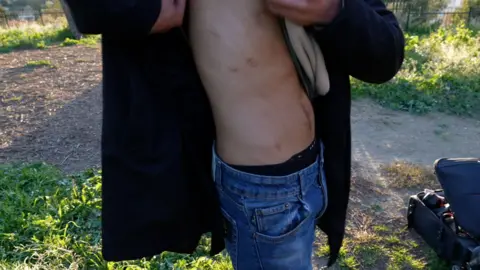
"It's chaos now," said a scrawny gang-member, lifting his shirt in a nearby park to show us a torso marked by the scars of at least four bullets - the result of an attempted assassination by a rival gang.
France's Ministry of Justice estimates that the number of teenagers involved in the drugs trade has risen more than four-fold in the past eight years.
"I've been in [a gang] since I was 15. But everything has changed now. The codes, the rules – there are no more rules. Nobody respects anything these days. The bosses start... to use youngsters. They pay them peanuts. And they end up killing others for no real reason. It's anarchy, all over town," said the man, now in his early 20s, who asked us to use his nickname, The Immortal.
Across Marseille, police, lawyers, politicians and community organisers talk of a psychose – a state of collective trauma or panic – gripping parts of the city, as they debate whether to fight back with ever tougher police action or with fresh attempts to address entrenched poverty.
"It's an atmosphere of fear. It's obvious that the drug traffickers are dominant, and gaining more ground every day," said a local lawyer, who asked to remain anonymous for fear of reprisals against her or her family.
"The rule of law is now subordinate to the gangs. Until we have a strong state again, we have to take precautions," she said, explaining her recent decision to stop representing victims of gang violence.
During the summer, several French cities imposed night-time curfews on teenagers after a spate of violence linked to drug trafficking.
President Emmanuel Macron was holding talks on Thursday in an attempt to respond to the crisis.
"There's so much competition in the drugs trade that... people are ready to do anything," said community organiser Mohamed Benmeddour. "So, we have kids aged 13 or 14 who come in as lookouts or dealers. The young see dead bodies, they hear about it, every day. And they're no longer afraid of killing, or being killed."
The trigger for Marseille's current psychose was the murder, last month, of Mehdi Kessaci, a 20-year-old trainee policeman with no links to the drug trade. It is widely believed his death was intended as a warning to his brother, a prominent 22-year-old anti-gang activist and aspiring politician named Amine Kessaci.
Under close police protection now, Kessaci spoke to the BBC about Mehdi's death, and the guilt he feels.
"Should I have made my family leave [Marseille]? The struggle of my life is going to be this fight against guilt," he said.
 AFP via Getty Images
Amine Kessaci first rose to national prominence in 2020, after his older brother, a gang member named Brahim, was also murdered.
"We've had this psychose for years. We've known that our lives are hanging by a single thread. But everything changed since Covid. The perpetrators are getting younger and younger. The victims are younger and younger," he said.
"My little brother was an innocent victim. There was a time when the real thugs... had a moral code. You don't kill in daytime. Not in front of everyone. You don't burn bodies. First you threaten with a shot to the leg... Today these steps have all disappeared."
Citing today's "unprecedented" levels of violence, French police are responding with what they call security "bombardments" in high-crime areas of Marseille.
Although one gang, the DZ Mafia, now appears to dominate the trade, it operates a kind of franchise system, with a fractious network of small distributors often staffed by teenagers and undocumented immigrants, who clash violently over territory.
According to one estimate, up to 20,000 people may be involved in the city's drug industry. Last year officials confiscated €42m (£36m) in criminal assets from the gangs.
Video footage shared on social media routinely shows gang members, armed with automatic rifles, shooting at each other in Marseille's various cités – poor neighbourhoods characterised by high-rise buildings and a concentration of social housing.
On a cold afternoon last week, we accompanied a group of armed riot police on one of their regular "bombardment" missions.
The officers sped up to a dilapidated block of flats in their vans as a youthful gang look-out on the gate promptly fled on foot. Splitting into two groups, the police ran up either side of the building seeking to catch dealers in the stairwells.
"The aim is to disrupt the drug dealing spots. We've closed more than 40 of them... and we've locked up a lot of people," explained Sébastien Lautard, a regional police chief.
"Turn him round," said an officer, brusquely, as his team pinned an 18-year-old up against a door.
In a filthy cellar nearby, the police found dozens of vials and tiny plastic bags used to distribute cocaine. Later, a policeman explained that the young man they had detained was pleading to be arrested, saying he had come to Marseille from another city, and was now being held against his will and forced to work for a drug gang.
The officers took him away in a van.
"This is not El Dorado. We have a lot of youngsters recruited on social media. They come to Marseille thinking they'll make easy money. They're promised €200 ($233;£175) a day. But it often ends in misery, violence and sometimes death," said the city's chief prosecutor, Nicolas Bessone.
In his office close to the city's old harbour, Bessone described an industry thought to be worth up to €7bn nationwide and characterised by two new developments: a growing emphasis on online recruitment, sales, and delivery; and a rising number of teenagers coerced into the trade.
"We now see how the traffickers enslave these... little soldiers. They create fictional debts to make them work for free. They torture them if they steal €20 to buy a sandwich. It's ultra-violence. The average age of the perpetrators and victims is getting younger and younger," said Bessone.
He urged local people not to succumb to a psychose but instead to "react, to rise up".
The lawyer who asked us to hide her identity described a case she had handled.
"One young person, who absolutely didn't want to be part of a network, was picked up after school, forced to participate in the drugs trade, was raped, then threatened, then his family also threatened. All means are used to create a workforce," she said.
On Tiktok, dozens of videos, set to music, advertise drugs for sale in Marseille's cités, "from 10:00 to midnight", each product with its own emoji, for cocaine, hashish and marijuana. Other adverts seek to recruit new gang members with messages like "recruiting a worker", "€250 for lookouts", "€500 to carry drugs".
For some local politicians, the answer to Marseille's troubles is a state of emergency, and far tougher rules on immigration.
"Authority must be restored. We need to end a culture of permissiveness in our country. We need to give more freedom, more power to the police and the judiciary," said Franck Alissio, a local MP for the populist, far-right National Rally party, and a prospective mayoral candidate.
Although the ancient Mediterranean city of Marseille has, for centuries, been known for its large immigrant community, Alissio argued that "today, the problem is that we are no longer able to integrate economically and assimilate. Too much immigration. It's the number [of immigrants] that's the problem. And in fact, the drug traffickers, dealers, lookouts, the leaders of these mafia, are almost all immigrants or foreigners with dual nationality."
It is a controversial claim that is hard to verify in a country that strives to avoid including such details in official figures.
Alissio claimed that billions of euros had been poured into Marseille's poorest neighborhoods by successive governments to no effect. He blamed parents and schools for allowing children into the drugs trade but added that he was focused on "solving the problem, not doing sociology".
Far-right parties have long enjoyed strong support across the south of France, but less so in the diverse city of Marseille itself. Critics of the RN, like the lawyer whose identity we have concealed, accused the party of "exploiting misery and fear," and wrongly blaming immigrants for a "gangrene" that is widespread across all communities in France.
Philippe Pujol, a local writer and expert on the drug trade in Marseille, was also offered police protection after the murder of Mehdi Kessaci last month.
"I'm not sure if there's a good reason for this terror. But... terror is taking hold. I would rather be afraid and careful than take unnecessary risks," he said.
But he hit back against calls for tougher police action, arguing it was merely nursing the symptoms "of a suffering society", rather than treating the causes of the problem.
Describing entrenched poverty as a "monster," Pujol painted a picture of a society radicalised by decades of neglect.
"The monster is a mixture of patronage, corruption, and political and economic decisions made against the public interest," Pujol said.
"These kids can be jerks when they're in a group, but when you're alone with them, they're still children, with dreams, who don't want this violence."