'The dishonest officer should fear the honest one': The policeman who inspired Al Pacino's Serpico

 Getty Images
Frank Serpico was shot on 3 February 1971, after exposing corruption in the NYPD. The following year, the BBC reported on the "widespread" rot in the Big Apple's police force.
The 1973 crime drama Serpico was ripped straight from the headlines. Based on Peter Maas's non-fiction bestseller, the film cast Al Pacino, fresh from his role as Michael Corleone in The Godfather, as the idealistic policeman Frank Serpico, who dared to confront the corruption in the New York City Police Department (NYPD).
His stubborn honesty put him at odds with his colleagues. But was it linked to the moment, on 3 February 1971, when he was shot during a narcotics raid? The BBC reported on the subsequent inquiry in 1972.
Serpico, the son of Italian immigrants, joined the NYPD in 1959 in order to serve the community. In 1965, he became a plain-clothes officer, a step towards becoming a detective. His idealism soon collided with the dishonesty of some of his fellow officers. Corruption was rife, he discovered. A cop could skim off $800 a month – the equivalent of around $8,000 (£5900) today – from gambling operations, with senior officers taking a share and a half.
In 1967, Serpico became a whistleblower, bringing evidence of such corruption to his bosses. In return, he was bullied and threatened. He was then joined in his crusade by David Durk, another courageous NYPD officer who had contacts in high places. While Durk was a clean-cut law graduate and family man, Serpico was an unconventional free spirit and a loner – another reason why he was unpopular with his colleagues.
In 1970, disillusioned and out of options, Serpico and Durk took their findings to the New York Times. The dynamite front-page revelations shook the city. Mayor John Lindsay appointed an independent commission led by Wall Street lawyer Whitman Knapp. But Serpico was still on active duty.
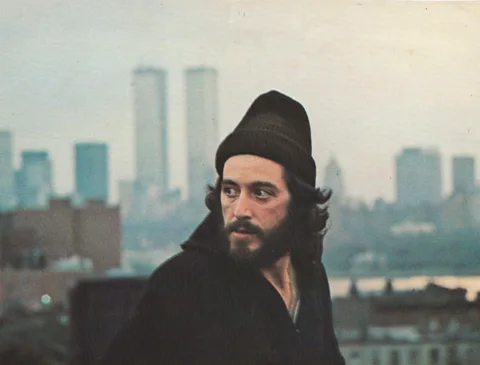 Alamy
AlamyIn February 1971, by now in the narcotics division, he went to an apartment building in Brooklyn with three fellow officers after they had a tip-off that a drug deal was planned. Serpico knocked on the suspect's door and pushed his way in when it was opened, but he was shot in the face. A senior police official told New York Magazine that when the news came in, "We were terrified that a cop had done it."
According to New York Magazine, Serpico was "left for dead by his fellow officers", and it was up to a man who lived in the building to call the emergency services. He was then driven to hospital in a police car. In a 2014 Politico article, he wrote: "One of the officers who drove me that night said [later], 'If I knew it was him, I would have left him there to bleed to death.'"
A year later, David Taylor of the BBC's 24 Hours programme reported from the frontline of a city where the crime statistics were "those of a war in progress". He found that not only was New York the wealthiest city in the world, it was also one of the most squalid. "Last year, there were 1,600 murders in the city. More Americans were killed here than in Vietnam. There's a violent crime every 15 minutes, a mugging every minute and a burglary every 30 seconds."
"But what makes matters much worse is the common knowledge that the cops are on the take," said Taylor. The public inquiry found corruption to be "widespread, although by no means uniform in degree". It dubbed most of the corrupt cops "grass-eaters". These were officers who accepted small payoffs and gratuities from "contractors, tow-truck operators, gamblers and the like". "Meat-eaters", a small percentage of the NYPD, would aggressively exploit situations in return for large payoffs. These would involve "gambling, narcotics and other serious offences which can yield payments of thousands of dollars".
In History
In History is a series which uses the BBC's unique audio and video archive to explore historical events that still resonate today. Sign up to the accompanying weekly newsletter.
The star witness at the televised hearings was William Phillips, a plain-clothes officer who had been taking bribes for 14 years. A homicide detective who watched him testify on television told prosecutors that he resembled the police sketch of a suspect in an unsolved murder case from 1968. Phillips ended up being convicted of killing two people and went to prison for 32 years. He died in 2023, aged 92. In his obituary, the New York Times posed the question, "Did he commit murder, or was he framed in retaliation for breaking the blue wall of silence?"
More than just a few bad apples
Serpico, partially deafened in one ear by the shooting, testified in the inquiry himself, saying: "I hope that police officers in the future will not experience the same frustration and anxiety that I was subjected to for the past five years at the hands of my superiors because of my attempt to report corruption. I was made to feel that I had burdened them with an unwanted task." He urged police hierarchy to create "an atmosphere in which the dishonest officer fears the honest one and not the other way around".
Durk told the commission: "Corruption is not about money at all, because there is no amount of money that you can pay a cop to risk his life 365 days a year. Being a cop is a vocation or it is nothing at all, and that's what I saw destroyed by the corruption of the New York City Police Department, destroyed for me and for thousands of others like me."
The BBC's 1972 report on the state of New York policing found a demoralised force. Captain Edward Rogers, commander of the Ninth Precinct, told 24 Hours: "Morale is at a very low ebb at this time in the department due to the Knapp Commission, when 95% of honest men are now being labelled corrupt, when the Knapp Commission at the most revealed maybe 5% of the department is corrupt. The other 95% are bearing the brunt of this corrupt label." He added: "Something of this type has certainly put us back for many years in our relations with the public, and unjustifiably so."
More like this:
• How Goodfellas reinvented the gangster film
• How a 2003 blackout brought New York to a standstill
• The only X-rated winner of the best-picture Oscar
Durk told the BBC that the commission's big achievement was to have "dispensed with the rotten apple theory" that had previously been the response to any police corruption allegations. "The administration would always say, 'What? Shocking, terrible, show us the villain and we will hang him.' And they usually make a very dramatic show of hanging one or two… usually quite low-level people. I think what the Knapp Commission did was to show the extent and the seriousness of what corruption really means."
When it came to making the film of the fight against corruption, Durk's role in events was represented by Bob Blair, a fictionalised character played by Tony Roberts. After the commission hearings, Durk was promoted to lieutenant and remained in the police for more than a decade.
A disillusioned Serpico quit the force in 1972, and moved for a time to Switzerland. The biopic, directed by Sidney Lumet, came out in the US a year later. The poster's tagline read: "Many of his fellow officers considered him the most dangerous man alive – an honest cop." Thirty years after that, in 2003, the American Film Institute ranked Frank Serpico at number 40 on its list of the greatest heroes in US cinema history.
--
For more stories and never-before-published radio scripts to your inbox, sign up to the In History newsletter, while The Essential List delivers a handpicked selection of features and insights twice a week.
For more Culture stories from the BBC, follow us on Facebook and Instagram.