Mountain biking the Himalayas in Everest's shadow

 Phaplu Mountain Bike Club
A new adrenaline-fuelled experience is allowing travellers to see the Himalayas in a new way – and helping local Sherpa residents in the process.
Hurtling downhill on a mountain bike in the Himalayas, I was exhilarated, slightly out of breath and secretly worried that a dzo – a yak-cow crossbreed – was going to amble out of the trees into my path, horns first.
"Keep your eyes up, trust your brakes and let the trail guide you," said Mingmar Yangzi Sherpa, pedalling ahead of me on a winding dirt path in Nepal's mountainous Solukhumbu District.
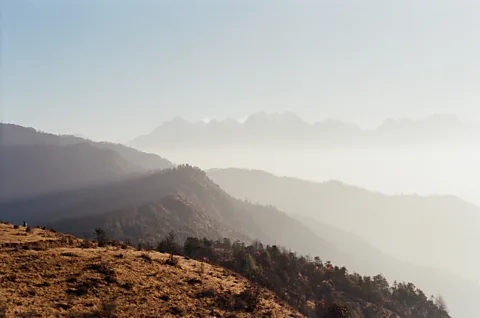
We paused where the path levelled out atop a grassy hill, offering a view of endless peaks in the distance. "Mountain biking here lets travellers explore beyond trekking routes, see local life up close and feel true adventure," she said. "It's perfect for anyone who wants more than sightseeing, who wants to feel the land, the culture, the experience of a homestay and the freedom of a ride at altitudes up to 4,060m."
 Phaplu Mountain Biking Club
Nepal is far better known for its mountains than its mountain biking. But within sight of the world's most famous summit, a grassroots movement is developing in the small town of Phaplu to help travellers experience the Himalayas in a new way and empower the local Sherpa people.
While Mount Everest's record-breaking ascents and overcrowding often dominate headlines, a broader reality receives less attention: many Nepalis – including the Sherpas who work as seasonal guides and porters – struggle to secure stable year-round incomes. Sherpa guides can earn anywhere from 588,000 to 1,765,00 Nepalese rupees (£2,900 to £8,700) during the two-month climbing season. This is relatively high by Nepali standards, but it's a fraction of what Western guides employed by international operators earn for the same dangerous work.
"Despite their indispensable contributions, Sherpas often find themselves at the short end of the economic stick," wrote Lauren McKenna for The Borgen Project, an organisation addressing poverty. "While expedition leaders and adventure companies reap substantial financial rewards from high-priced mountaineering expeditions, Sherpas receive meagre wages for their laborious work."
Against this backdrop, the nonprofit Phaplu Mountain Bike Club is betting that the region's dramatic peaks and pristine forests can attract more than elite climbers. The club has developed a network of 17 beginner- to expert-level trails stretching 70km in the community-managed Ratnange Forest, with the aim of creating local jobs that young Sherpa residents can design, lead and own.
 Phaplu Mountain Biking Club
Founded in 2020 by hospitality director Ang Tshering Lama and French ex-pro mountain bike racer Tangi Rebours, the club collaborates with tour operators to bring novice mountain bikers and hardcore devotees alike to this north-eastern corner of the country. In 2023, it launched the annual Enduro Ratnange race, a four-day December event that now attracts international pros.
As the trails have developed, Lama and Rebours have encouraged Sherpa families to open homestays, allowing visitors to immerse themselves in local culture. Bikers can also bed down in the lavish, 10-room Happy House lodge, owned by Lama's family and once favoured by legendary Everest mountaineer Sir Edmund Hillary.
"I love mountain biking in Solukhumbu," said Mingmar, who also manages activities at Happy House. "The air is clean, the people are warm and the terrain is wild in the best way. You can go from smooth single track to [a root-studded] technical descent, all while surrounded by some of the biggest mountains on Earth."
 Phaplu Mountain Biking Club
Mountain biking devotees have been aware of the sport's potential in Nepal for several decades. In 2003, Rebours co-founded Enduro MTB Nepal, which leads small-group, 14-day mountain biking trips in different regions, from Mustang to Solukhumbu. But in recent years, Phaplu's growing scene has attracted curious beginners, including myself.
After two nights in Kathmandu, I took a 45-minute charter flight to Phaplu, where I stayed in a spacious room at Happy House, and spent an afternoon learning mountain biking basics courtesy of Nepali-owned Beyul Experiences.
More like this:
• The 109km trail opening up the Canadian Rockies
• The Lower Dolpo Circuit: A 220km trek to the roof of the world
• Chhurpi: The world's hardest cheese?
"Because of [the popularity of climbing] Mount Everest, we've always been deep in the shadows," Lama told me one evening. "But projects like mountain biking have so much potential for communities to grow strong."
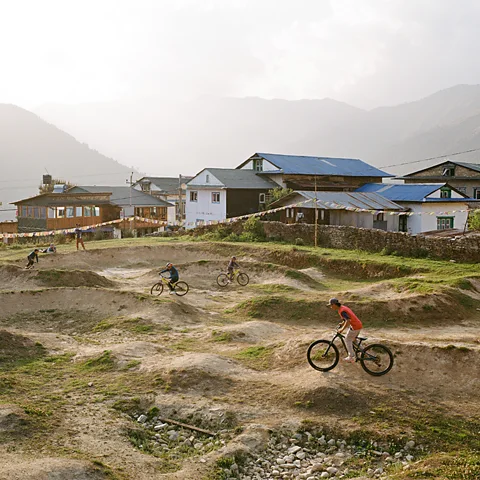
Thanks to funding from organisations including the Himalayan Trust and The Conscious Travel Foundation, the club obtained mountain bikes, built a new practice track and now trains local youth in everything from bike maintenance to first aid while teaching them how to guide fellow riders.
 Josh Griggs
One afternoon, I walked down to the track and watched a group of local boys pedalling in figure-eight loops around banked turns. The soft tick of wheel spokes mingled with triumphant whoops.
One of the boys was 17-year-old Ajay Kulung. "I love being in the nature here," Kulung said, explaining what drew him to the sport. "You can see a lot of things from the top of the mountains." Behind me, 19-year-old Manisha BK was watching the riders. Before long, she too was on a bike, her pink fluffy sweater illuminated in the sunlight.
"There is huge growth potential for young people," Lama said. "If you're starting as a mountain bike guide, you can earn $20 (£14.50) per day or more… The next generations can become entrepreneurs running touring companies, shopkeepers or mechanics – there's a huge demand for professional MTB mechanics in this country."
Globally, mountain biking is a $12.6bn industry – and it's estimated to double by 2032. Nepal's appeal lies in its mix of beginner-friendly and expert trails, mild weather and good terrain.
 Josh Griggs
"The dirt is good quality here – the loam [forest dirt] is healthy and has good grip," Rebours said. "You can ride here for 10-11 months of the year."
The Ratnange Forest's high elevation (3,280m) adds to the draw. Riding at altitude offers endurance benefits similar to those sought by elite athletes training in high-elevation regions elsewhere in the world.
One morning I set out on a 3.5-hour hike to the top of Ratnange ridgeline to see the trails. In the spring heat, the evergreen needles under my boots smelled of warm pine, and pink rhododendron flowers lay on the ground like chewed bubblegum. Many of the trails follow old footpaths used by herders and farmers generations. Lama and Rebours told me that another benefit of the growing mountain biking scene here is that it dissuades illegal logging and hunting.
The following day, a short drive took me to Garikhasa, a small village at the base of some of the club's trails, to meet locals who have opened homestays for foreign visitors. My first stop was the whitewashed home of Ang Babu Sherpa, his wife Ngima and their daughter, Pashi. As I approached, I passed a prayer wall hand-carved with Buddhist mantras, its edges softened with age and furred with red moss.
 Josh Griggs
Ngima welcomed me with hot tea and proudly told me that many visiting mountain bikers have enjoyed her traditional Sherpa dishes: nutritious shyakpa stew with broth, spinach, beef and corn; potato curries and lentil soups; and cheeses she makes with milk from the family's three cows.
"I was worried at first that they might not like my cooking," she said me. "But they ate everything and promised to stay with me again for the next race. Everyone calls me 'Mom' when they stay here."
Next, I visited Dawa Sherpa, who moved back to Solukhumbu after living in Kathmandu and now helps manage the Phaplu Mountain Bike Club's logistics, including arranging shuttle transports and welcoming travellers to his own homestay. Dawa's goal is to help his family live in the area full-time and set his young children up for a successful lifestyle.
"I want my children to stay in this region, working and getting paid while living close by," he said. "This is a peaceful place."
 Samantha Falewée
Everest still looms over the region – physically and economically. But as the Phaplu club continues to expand, more travellers and young Sherpas are turning their gaze away from the summit and towards these trails. In this quieter corner of the Himalayas, a different kind of adventure is taking shape.
--
If you liked this story, sign up for The Essential List newsletter – a handpicked selection of features, videos and can't-miss news, delivered to your inbox twice a week.
For more Travel stories from the BBC, follow us on Facebook and Instagram.